


Table of Contents
INTRO
Three words nobody expected to hear this soon: Open AI did it.
AI Todays News can confirm — Open AI’s GPT-6, the most powerful artificial intelligence model ever built by any company on earth, is confirmed for global launch on April 14, 2026. And the details behind this model will genuinely make your jaw drop.
This is not an update. This is not a patch. This is two full years of secret research, billions of dollars, and the entire weight of OpenAI’s ambition — packed into a single model that is 40% smarter than anything that existed before it.
The switch flips in days. And nothing after that will look the same.
Breaking: Open AI Confirms GPT-6 — The Biggest AI Launch in History
On April 7, 2026, OpenAI made it official. GPT-6 — internally codenamed “Spud” — launches globally on April 14, 2026. Pre-training finished on March 17. Post-training is complete. Safety evaluations are done. The model is sitting on servers in Texas right now, fully built, fully tested, waiting for launch day.
OpenAI President Greg Brockman went on the Big Technology Podcast and did not hold back. He said this model carries “two years of research” inside it and described it as feeling like “a significant change in the way we think about model development.” Those are not the words of someone describing a minor update.
Sam Altman called it “a very strong model that could really accelerate the economy.” Think about that for a second. The CEO of the most powerful AI company on earth said his new model could accelerate the entire global economy. That is a statement with weight behind it.
The codename “Spud” sounds casual. The reality behind it is anything but. This is the model OpenAI has been quietly building for two full years while the public was focused on smaller updates. The real thing is finally here.
Why Open AI’s GPT-6 Matters To Every Single Person on Earth
GPT-6 outperforms every previous AI model by more than 40% across coding, reasoning, and real-world agent tasks. To understand what 40% means — the jump from GPT-3 to GPT-4 shocked the entire world. This jump is wider. In a single release.
OpenAI quietly entered what insiders called “Code Red” mode in December 2025. The reason was alarming for them — competitors like Claude and Gemini were closing the performance gap faster than OpenAI’s own leadership had predicted. GPT-6 is the direct answer. Built not just to reclaim the lead, but to be an entire generation ahead of everyone else.
The scale of OpenAI today makes this a global event, not just a tech story. The company is at $25 billion in annual revenue, nearly one billion weekly active users, and a valuation of $852 billion. When a company that size drops its most powerful product ever — every business, every developer, and every worker on earth needs to pay attention.
April 2026 is already being called by AI researchers the most consequential month in the history of artificial intelligence. That is not a blogger’s opinion. That is the people who actually build these systems telling you directly — what is coming is unlike anything before.
How Open AI’s GPT-6 Works — Explained So Anyone Can Understand
Every AI model before GPT-6 was built for text first. Then images were added. Then audio. Then video. They were all separate systems bolted together. GPT-6 destroys that approach entirely. Its new architecture — called Symphony — encodes text, audio, images, and video all into the same system from the very beginning. Nothing is added on. Everything works together natively from day one.
The context window is 2 million tokens. In plain human English — GPT-6 can hold 1.5 million words in its active memory during a single conversation. That is two full copies of a 900-page trilogy, processed and remembered with near-perfect accuracy. Long-context retention is confirmed above 98%. The problem of AI “forgetting” earlier parts of your conversation is essentially solved.
Here are the benchmark numbers that stopped developers cold when they leaked:
- Coding accuracy: HumanEval scores pushing past 95%
- Math reasoning: Hitting approximately 85% on complex benchmarks
- AI agent task completion: Jumping from 62% to roughly 87%
- Factual error reduction: 33% fewer mistakes compared to the previous model
These are not incremental improvements. These are the kinds of numbers that make a model genuinely more capable than most human professionals working on the same tasks alone. That is the honest truth of what GPT-6 is.
What Open AI’s GPT-6 Means For Your Job, Business and Daily Life
The impact on businesses is not coming in five years. It is landing on April 14. Here is what changes immediately across every industry:
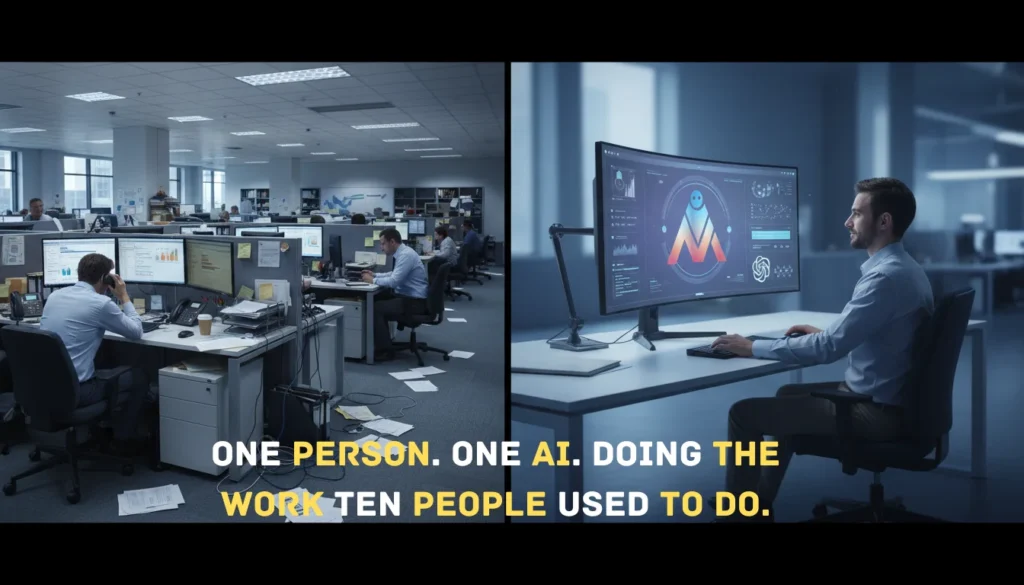
- Software teams: One developer handles complex projects that previously needed five people
- Legal departments: Full contracts and case files reviewed and analyzed in minutes
- Healthcare providers: Patient history, research, and diagnostics processed together in one workflow
- Marketing teams: Complete campaign strategy, copy, and creative direction from one AI session
- Finance departments: Hundreds of reports and documents cross-analyzed without losing a single data point
- Small businesses: For the first time, a one-person operation has access to something that works like a full professional team
For regular people — not developers, not executives — the change is just as real. Students get a tutor that genuinely understands where they are struggling, not one that just delivers answers. Freelancers can produce ten times their current output in the same hours. Anyone running a small business finally has a tool that thinks, plans, and executes alongside them.
Pricing is designed to stay accessible. Input costs $2.50 per million tokens. Output costs $12 per million tokens. Essentially flat compared to the previous model. One source inside OpenAI described it simply as “the most powerful AI ever built, priced so that anyone can actually use it.”
GPT-6 also merges ChatGPT, Codex, and the Atlas browser into one single desktop application. One screen. One model. Browse the web, write code, and have a full conversation — all without switching tools or losing context between them.
What Happens After April 14 — The Next 12 Months of AI
GPT-6 does not arrive alone. Anthropic’s Claude Mythos — accidentally leaked on March 26, 2026, and described internally as “the most powerful model we have ever built” — is expected in the same April window. Two of the greatest AI models ever created, launching within days of each other, competing for the same developers and businesses.
DeepSeek V4, Grok 5, and Gemini 3.2 are all arriving in this same period. Every major AI company on earth is playing its strongest card in Q2 2026. Researchers are already calling this the most intense quarter in the history of AI development — and whoever wins this window will likely define the industry for the next five years.
The numbers behind what comes next are staggering. Analysts project that 30% of all knowledge work will be AI-assisted by 2027. By 2030, that number crosses 60%. These are not science fiction predictions. These are forecasts built on the rate of change we have already seen — and GPT-6 accelerates that rate significantly.
The window to get ahead is open right now. The companies building on GPT-6 today will produce the products everyone else uses in two years. The individuals learning to work with it now will be the decision-makers in five. The ones waiting to see how it plays out will be the ones asking later how they missed it.
BENEFITS
- Understand that GPT-6 is a full architecture revolution — not a software update
- Know that 40% better performance means a generational leap happened in a single release
- Recognize that 2 million token context means your entire project fits in one conversation
- Learn that Symphony Architecture makes text, audio, video, and images fully native — not added on
- Prepare your business now — AI agents handling real multi-step workflows arrive April 14
- Notice that pricing stays accessible — this is not just for large corporations anymore
- Track the GPT-6 versus Claude Mythos competition — it defines the next era of AI entirely
- Anticipate that AI is becoming a professional colleague, not just a productivity tool
- Act immediately — companies adopting GPT-6 in April gain a structural advantage within months
- Remember that every major technology shift rewards the people who move first, not the ones who wait
CLOSING
We have watched AI improve steadily for years. Better answers. Faster responses. Fewer mistakes. Each step felt meaningful in the moment and forgettable six months later. GPT-6 is something structurally different. This is the moment the line between “AI assistant” and “AI colleague” disappears — and it is happening not in some distant future, but on April 14, 2026.
The companies that recognize this today will build the products that define the next decade. The people who start working with this now will be making the decisions everyone else follows in five years. And the ones who treat this as just another tech headline will look back at this week as the moment the race started — and they stayed on the bench.
What do YOU think about Open AI’s GPT-6 and what it means for the future?
This is the kind of news that changes everything — and we want to hear your thoughts.
Drop your opinion in the comments below.
Share this post with one person who needs to read this.
And if you want to stay ahead of the AI revolution every single day — follow AI TODAYS NEWS right now.
The future is moving fast. Don’t get left behind.