


Table of Contents ( META )
⚡ INTRO — META AI CHIP DEAL
Meta AI chip deal is shaking the entire global technology industry right now, and at AI Todays News, we are tracking this as a major turning point in the AI revolution.
This is not just another corporate partnership — it is a direct challenge to the dominance of chip giants and the future of artificial intelligence itself.
What Meta is building could change how AI systems are powered across the world.
And the impact? It goes far beyond Silicon Valley — it reaches every user, every device, and every digital system we use daily.
⚙️ META ENTERS FULL AI CHIP WAR STRATEGY
Meta has officially expanded its partnership with Broadcom to design and build custom AI chips, marking a major shift in the global AI industry.
The main goal of this move is to reduce Meta’s heavy dependence on Nvidia, which currently dominates the AI chip market. Nvidia’s GPUs power most of the world’s advanced AI systems, but rising demand and high costs have pushed big tech companies to look for their own solutions.
With this partnership, Meta wants to design chips that are fully optimized for its own AI systems. Instead of relying on general-purpose hardware, these custom chips will be built specifically for Meta’s platforms like Facebook, Instagram, WhatsApp, and its AI research tools.
This gives Meta more control over speed, performance, and efficiency. It also helps reduce long-term costs and improves how AI models are trained and run across its massive infrastructure.
More importantly, this move shows a bigger trend in the tech world — companies are no longer just software builders. They are becoming hardware creators too, trying to control the entire AI system from chip level to application level.
If successful, this could make Meta’s AI systems faster, smarter, and more independent than ever before.
💥 WHY THIS DEAL CHANGES GLOBAL TECH POWER
This deal is extremely important because artificial intelligence today is completely dependent on massive computing power, and that power comes from advanced chips. In simple terms, whoever controls the chips essentially controls the speed, capability, and future direction of AI itself.
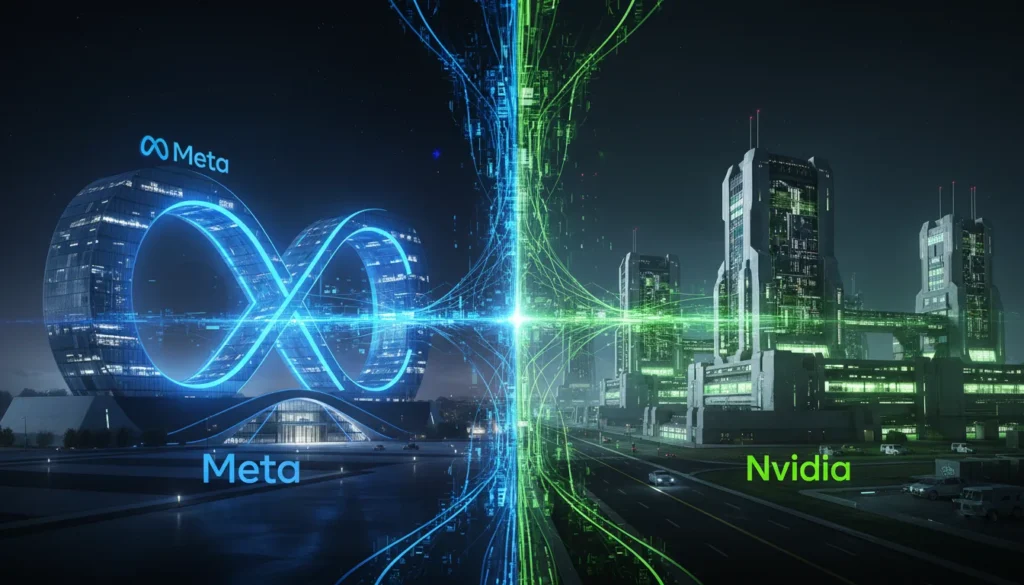
Meta stepping into custom chip design is not just a technical upgrade — it is a direct challenge to the existing dominance of major semiconductor giants like Nvidia and AMD. These companies have long controlled the AI hardware ecosystem, but now Big Tech companies are actively trying to reduce that dependency and build their own internal systems.
This shift represents a much deeper transformation happening across the entire tech industry. Companies are no longer satisfied with only building software or AI models. Instead, they want full control over the entire technology stack — from the physical hardware (chips), to the software layer, to the final AI intelligence that users interact with.
By moving into chip design, Meta is signaling that the future of AI will not be controlled by a few hardware suppliers, but by vertically integrated tech giants who manage everything in-house. This gives them more power, more efficiency, and more strategic independence in the rapidly growing AI race.
🧠 HOW META’S CUSTOM AI CHIPS WORK
Meta’s custom AI chips are designed specifically for heavy AI tasks like training models, running recommendation systems, and processing massive data in real time.
Unlike normal chips, these are optimized only for AI, making them faster, more efficient, and better suited for large-scale operations.
This helps platforms like Facebook, Instagram, and WhatsApp deliver smarter features, faster performance, and lower operational costs at a massive scale.
🌍 REAL-WORLD IMPACT ON USERS AND BUSINESSES

For everyday users, this shift means a noticeable upgrade in how apps actually feel and respond. AI features will become faster, more accurate, and more personalized. Social media feeds will get smarter, recommendations will match user interests more closely, and virtual assistants will respond more quickly and naturally. Overall, the experience becomes smoother, more engaging, and almost instant.
For businesses, the impact is even bigger. Companies will gain access to more powerful AI-driven tools for advertising, customer targeting, and data analysis. This means better decision-making, more precise marketing strategies, and higher returns from digital campaigns. AI will be able to process deeper insights from user behavior, helping businesses understand their audience like never before.
However, this progress also brings a serious concern — centralization of power. As companies like Meta build their own AI chips and infrastructure, control over the digital ecosystem becomes concentrated in fewer hands. This could limit competition, increase dependency on big tech platforms, and raise questions about fairness, transparency, and long-term control of the internet’s core technology.
🔮 FUTURE OF AI: THE CHIP DOMINANCE ERA

This move is not just a one-time strategy — it signals the beginning of a much larger global shift where major tech companies will increasingly build their own custom chips instead of relying on external suppliers. The goal is clear: more control, better performance, and complete independence in the rapidly growing AI ecosystem.
We are now entering a new era where AI power is no longer defined only by how intelligent the software is, but also by who controls the underlying hardware. In simple terms, the companies that design and own their own chips will have a major advantage in speed, efficiency, and scalability. This changes the entire balance of power in the tech industry.
Over the next few years, this shift is expected to intensify competition between major players like Meta, Google, Microsoft, and Nvidia. Each of them is racing to build stronger, faster, and more efficient AI systems — and the battle will not just be about algorithms anymore, but about who dominates the hardware layer of artificial intelligence.
📌 KEY TAKEAWAYS
- Meta is building custom AI chips for independence
- Broadcom partnership strengthens AI infrastructure
- Reduces reliance on Nvidia hardware
- AI chip wars are becoming global tech competition
- Faster AI performance across Meta platforms
- Lower long-term operational costs
- Strong push toward AI hardware control
- Big tech is entering semiconductor race
- AI systems will become more powerful and efficient
- Future internet will be fully AI-powered at hardware level
⚡ ENDING
This Meta AI chip deal is not just a business move — it is a signal that the AI world is entering a new phase of control, competition, and technological dominance.
What happens next will shape how every AI system works in the future, from social media to automation and beyond.
The AI revolution is no longer coming — it is already being built inside the chips we rarely think about.
“What do YOU think about Meta AI chip deal?
This is the kind of news that changes everything —
and we want to hear your thoughts.
Drop your opinion in the comments below.
Share this post with one person who needs to read this.
And if you want to stay ahead of the AI revolution
every single day — follow AI TODAYS NEWS right now.
The future is moving fast. Don’t get left behind.”