


Table of Contents ( Jobs Destroyed )
INTRO
Right now, as you read this, a company somewhere is replacing a human being with artificial intelligence — and calling it “progress.”
Your job might be next. And until last week, there was nothing anyone could do about it.
Bloomberg, NPR, Fortune, and TechCrunch all confirmed: a court just ruled that firing someone to replace them with AI is illegal — and companies must face consequences.
AI Todays News tracked this story from the moment it broke — because this is exactly the kind of ruling that changes what happens to millions of people like you.
But here’s what most people don’t know yet: this protection exists in only one country on Earth. And it is not India. It is not America. It is not Europe.
The Shocking Ruling That Just Changed Everything for Workers Worldwide
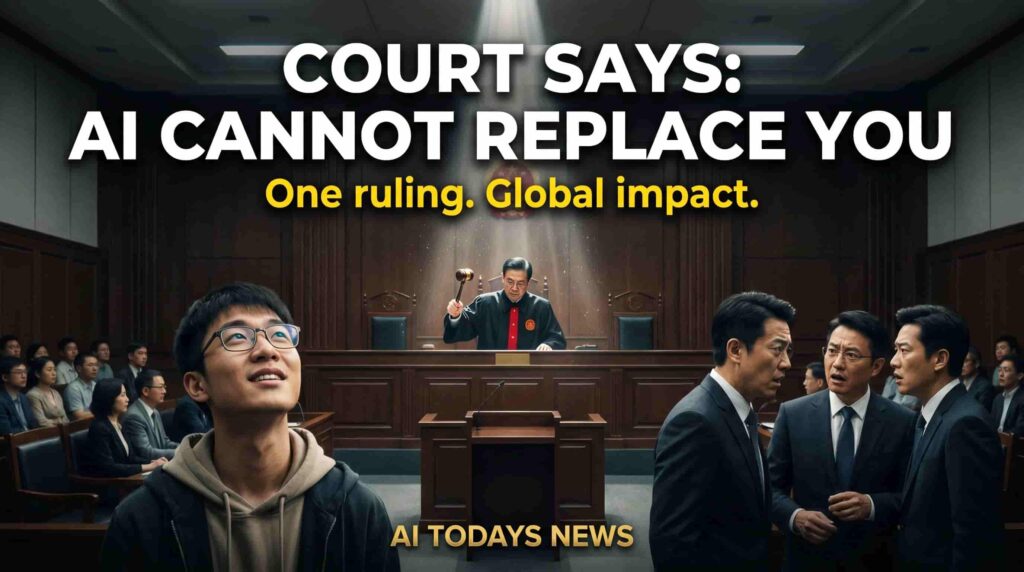
In Hangzhou, China — one of the world’s biggest AI hubs — a senior tech worker named Zhou lost his job in 2024. His company’s AI system had improved. His employer decided: the machine could do his job. Zhou was out.
What followed was not a protest. It was a lawsuit. And Zhou won.
The Hangzhou Intermediate People’s Court ruled the dismissal unlawful. The company had cited “major changes in objective circumstances” — the legal term required under China’s Labor Contract Law to justify firing someone. But the court said no. AI adoption is a voluntary business strategy. It is not an earthquake. It is not a merger. It is a choice the company made — and the cost of that choice cannot legally be transferred onto the employee.
So here is the question that should keep every employed person awake tonight: if this happened to Zhou — a tech worker at an AI company — could it happen to you?
Why People Exactly Like You Should Be Paying Attention Right Now
This is not a story about China. This is a story about you.
In 2026 alone, more than 80,000 tech workers have been laid off globally — and nearly half of those cuts were directly attributed to artificial intelligence replacing human roles. Meta cut 8,000 positions. Oracle eliminated up to 30,000 employees. Block went from 10,000 to 6,000 staff. Every announcement cited the same reason: AI.
India produces over 5 million engineering graduates a year. The IT sector employs 5+ million people directly. There is currently NO Indian law that prevents a company from firing you to deploy an AI system instead. None.
If you work in data entry, customer support, software testing, content writing, back-office operations, or any role involving repetitive digital tasks — you are the exact profile that companies are targeting for AI replacement right now.
While experts debate whether AI is “really” taking jobs, your company’s finance team is already calculating how much money they save if your role is automated. And they are not waiting for your opinion.
The Hidden Legal System Behind This Ruling — And Why It Makes Companies Furious
Think of it like this: imagine your landlord decides to renovate your apartment using a cheaper contractor. He cannot throw you out just because the renovation makes your room unnecessary. The cost of upgrading his property is not your problem to bear.
That is exactly how China’s court interpreted AI replacement. The company’s AI upgrade was their business decision. Their competitive strategy. Their investment. Not a natural disaster. Not an economic collapse. A choice they made with full awareness. And by firing Zhou, they were forcing him to personally absorb the financial consequence of a decision he had no part in making.
The ruling established a landmark principle: technological progress does not exempt companies from legal responsibility to their workers.
Here is what makes companies furious about this: they cannot claim “efficiency” or “progress” as a legal shield anymore. They must negotiate. They must offer real alternatives. They must pay real compensation. And in a world where every tech company is racing to cut headcount using AI as the justification — that single principle is worth billions of dollars in liability.

Real People. Real Consequences. This Is Already Happening Right Now.
In Shandong Province, China, a company replaced a former employee with an AI digital replica — a virtual version of the real person — and continued using it to perform his tasks after he left. The story went viral. The public was outraged. But no law stopped it.
In India, there is no equivalent of Zhou’s ruling. Companies restructuring around AI face no legal requirement to negotiate with affected employees, offer comparable positions, or pay enhanced severance. A company can openly cite AI efficiency in an earnings call, then lay off 2,000 people the same week — legally.
The workers most at risk are not the unskilled. They are mid-level professionals: data analysts, junior developers, customer experience managers, HR coordinators, content teams, logistics planners. People with degrees. People with EMIs. People with families depending on that salary.
The uncomfortable truth: the companies replacing people with AI are often the most profitable companies on earth. This is not desperation. This is optimization — and without legal protection, there is nothing between you and that optimization.

What Comes Next — And Exactly How to Protect Yourself
Legal experts predict that China’s ruling will trigger legislative pressure in other countries — the EU’s AI Act already classifies AI-driven employment decisions as high-risk. India’s IT Ministry has signaled awareness of the issue, but no concrete protections exist yet. The window before this hits India’s policy agenda is narrow — 12 to 24 months at most.
Most people will do nothing. They will wait. They will assume their company values loyalty. They will find out the truth in a video call on a Monday morning with HR.
Here are 3 things you can do today — not next month:
1. Audit your role: List every task you do weekly. Ask honestly: which of these could an LLM or automation tool do in under 5 minutes? The answer tells you your real exposure level.
2. Skill into AI workflows: Don’t compete with AI — become the person who manages it. Prompt engineering, AI tool integration, and data interpretation skills are what companies are desperately hiring for right now while cutting execution roles.
3. Document your unique value: Start building a portfolio of decisions, strategies, and outcomes that required human judgment. This is your legal and professional protection — evidence that what you do cannot be automated.
The AI revolution is not coming. It is here. The only question is whether you are positioned on top of it — or underneath it.
10 Key Takeaways You Need to Know
1 Understand that China’s court has now established: firing workers for AI replacement is legally unlawful — a global first.
2 Know that 80,000+ tech workers lost jobs to AI in the first 4 months of 2026 alone — this number is accelerating.
3 Realize India has ZERO legal protection against AI-driven layoffs — your employer can replace you today with full legality.
4 Recognize that mid-level professionals — analysts, developers, coordinators — are the highest-risk category, not unskilled workers.
5 Learn that companies must now prove AI replacement was “impossible to avoid” — not just “more efficient” — to fire legally in China.
6 Audit your role immediately — identify which of your tasks are automatable and build a transition plan before your company does it for you.
7 Invest in AI management skills — prompt engineering and AI tool supervision are the fastest-growing roles in tech right now in India.
8 Watch India’s IT Ministry policy announcements over the next 12 months — regulatory protection could arrive faster than expected under public pressure.
9 Share this ruling with your HR team — awareness in your organization may delay or change how AI restructuring decisions are made internally.
10 Remember: the workers who adapt to AI now will be irreplaceable tomorrow — the window to act is open, but it will not stay open long.
You now know something that millions of employed people around the world do not know yet.
A court has drawn a line — and said that companies cannot make their own technological greed your personal financial disaster. That matters. Even if it matters only in one country so far.
The same AI that passed Zhou’s termination letter is processing similar decisions at companies in Mumbai, Bengaluru, Hyderabad, and Pune right now. The machines are not malicious. The systems are just optimizing. The question is who controls those systems — and who the law protects when they optimize you out of existence.
What happens next matters more than what happened yesterday. And the people who understand this moment will be the ones who shape it.
What do YOU think about AI replacing jobs?
This is the kind of news that changes everything —
and we want to hear your thoughts.
Drop your opinion in the comments below.
Share this post with one person who needs to read this.
And if you want to stay ahead of the AI revolution every single day — follow AI TODAYS NEWS right now.
The future is moving fast. Don’t get left behind.