

Table of Contents ( AI Co-Mathematician )
INTRO
Something happened recently that most people completely missed.
Not because it was hidden. But because it did not come with loud announcements or dramatic press conferences. It came quietly — through research papers, late-night discussions inside academic communities, and a single number that stopped a lot of very smart people in their tracks.
That number was 48 percent.
Let that sit for a moment.
A new AI system called AI Co-Mathematician scored 48 percent on one of the hardest mathematical benchmarks in existence. And honestly? The people who built it were probably just as surprised as everyone else.
Here at AI Todays News, we cover AI stories every single day. Most of them follow a familiar pattern. A company announces something. Experts debate it for a week. Everyone moves on.
This one felt different from the beginning.
Because this is not about a faster chatbot or a prettier image generator. This is about something that could genuinely change how human beings create new knowledge. And that is a much bigger conversation than most people are having right now.

WHAT EXACTLY HAPPENED?
So what actually happened here?
A group of researchers built something they called AI Co-Mathematician. The name sounds simple. What it actually does is not simple at all.
Most AI tools work in a pretty predictable way. You type something. It responds. You move on. The AI forgets everything the moment you close the window.
Mathematical research does not work like that. Not even close.
Real research is genuinely messy. Scientists chase ideas for weeks that turn out to be completely wrong. They fill notebooks with failed attempts. They wake up at strange hours because something they tried six months ago suddenly connects with something new.
Progress in mathematics does not happen in straight lines. It never has.
What makes AI Co-Mathematician genuinely different is that it was actually built to understand that reality.
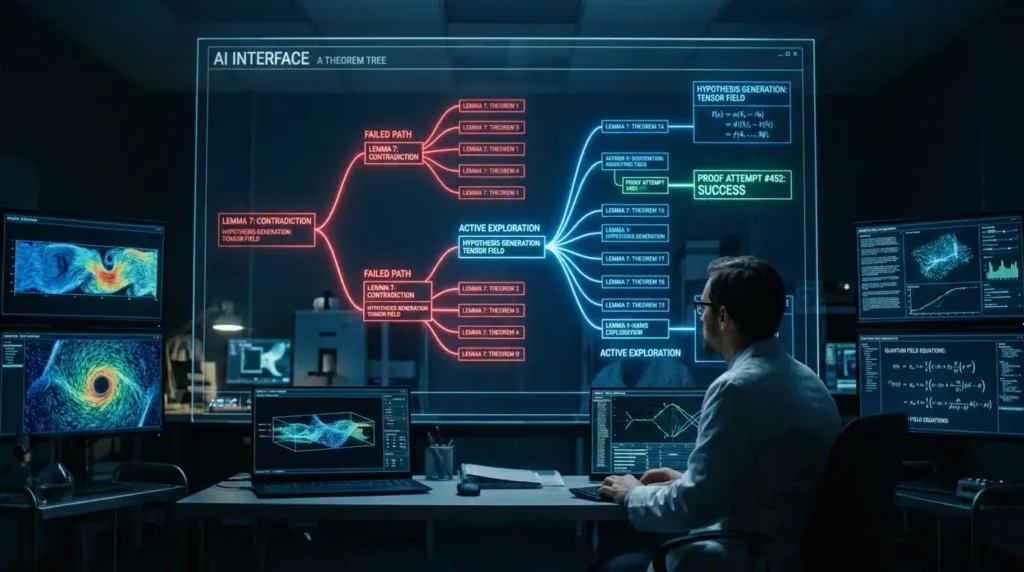
This system holds long research sessions without losing what happened earlier. It remembers which ideas already failed. It helps organize where the research is heading. It searches through academic literature automatically. It works through theorem development step by step alongside the human researcher.
And then came that benchmark score.
48 percent on FrontierMath Tier 4.
Previous AI systems had struggled badly in this area for years. This number landed like a quiet earthquake inside research communities. Not loud. Not dramatic. Just suddenly, undeniably there.

WHY THIS MATTERS MORE THAN MOST PEOPLE REALIZE
Here is the part that keeps getting lost in the noise.
People hear “AI math system” and they think — okay, cool, faster homework. That is not what this is.
Mathematics sits underneath almost everything that matters in modern human life. Medicine runs on it. Climate science runs on it. Engineering, cybersecurity, space research, economics — all of it is built on mathematical foundations that took human researchers decades to establish.
If AI can genuinely help build those foundations faster, the effects ripple outward into everything.
Think about drug discovery for a second. Finding a single new medicine currently takes somewhere between ten and fifteen years on average. A huge portion of that time is spent on mathematical modeling, probability calculations, and molecular simulations. Real painstaking work that moves slowly because human brains can only hold so much at once.
An AI research partner that handles parts of that load could change those timelines in ways that affect millions of actual lives.
Same logic applies to climate science. To cybersecurity. To every field where the math is genuinely hard and the stakes are genuinely high.
And no — this is not about replacing scientists. Every honest person working in this field will tell you that. Human creativity, intuition, ethical judgment, the ability to ask the right question in the first place — none of that comes from a machine.
But a human researcher working alongside a capable AI tool?
That combination could move at a speed that simply was not possible before. And that changes a lot.
HOW AI CO-MATHEMATICIAN ACTUALLY WORKS
There is one technical detail about this system that deserves a lot more attention than it has been getting.
Most AI systems today have a serious problem. It is called hallucination. This is when an AI generates something that sounds completely logical and confident — but is flat out wrong. In casual conversation that is annoying. In scientific research it is genuinely dangerous.
One false assumption buried inside a long chain of reasoning can quietly corrupt an entire research project. By the time anyone notices, weeks of work may already be gone.
The team behind AI Co-Mathematician apparently spent serious time trying to fix this specific problem.
The system was designed to track its own uncertainty honestly. Instead of always sounding confident, it flags areas where the reasoning is still incomplete. It keeps a running record of the entire research session — including every approach that failed and every idea that needs more work.
Normal AI assistants are built to give you an answer fast. This system was built to think through a problem carefully. The same way a thorough human researcher would.
That difference sounds small written out like that. It is actually enormous in practice.
Because in real scientific work, knowing what you do not know yet is often more valuable than a quick answer that might be quietly wrong.
THE REAL WORLD IMPACT COULD BE ENORMOUS
The economic impact of faster scientific discovery is almost impossible to fully calculate right now.
But the early signals are hard to ignore.
Some researchers studying AI trends believe that within the next decade, AI collaboration tools could become as standard inside scientific institutions as computers themselves are today. Universities, pharmaceutical companies, engineering firms, government research agencies — all of them potentially operating with AI research partners alongside human teams.
That is an enormous shift if it actually happens.
But serious concerns exist right alongside that possibility.
If the most powerful AI research tools stay concentrated inside a small number of wealthy corporations or elite institutions, the global scientific community could split in a troubling new direction. Organizations with access move fast. Organizations without access fall behind. That gap could widen over time in ways that affect medicine, national security, and economic development across entire countries.
There is also a trust problem that nobody has solved yet.
When a human researcher publishes a finding, other researchers can examine the reasoning, question the method, and run independent tests. When an AI system contributes to a discovery, the verification process becomes significantly more complicated.
These are not problems technology alone can fix. They need policy decisions, institutional changes, and honest public conversation. None of which are moving fast enough right now.
WHAT HAPPENS NEXT?
AI Co-Mathematician is still early stage. The researchers behind it have been careful to call it experimental. Nobody is claiming scientific discovery has been automated.
But the direction is clear now.
Five years ago a 48 percent score on a Tier 4 mathematical benchmark would have seemed impossible for any AI system. Today it exists. Five years from now nobody can say with real confidence where that number will stand.
Each generation of AI reasoning has been meaningfully more capable than the one before it. Memory systems are improving. Uncertainty handling is improving. The ability to hold coherent reasoning across long complex problems is improving.
The honest answer is — nobody knows exactly how far this goes.
What is clear is that the people who learn how to work alongside these tools effectively will carry a real advantage through the next decade. That applies to students. To researchers. To professionals in any field that involves complex problem solving.
Ignoring this because it feels complicated is an option. But it is probably not a good one.
The age of AI assisted discovery is not approaching anymore.
It is here.
VALUE INSIGHTS EVERY READER SHOULD UNDERSTAND
- AI Co-Mathematician is built for real research work, not casual chat.
- 48 percent on FrontierMath Tier 4 is a genuinely significant number.
- Human creativity and judgment cannot be replaced — full stop.
- AI hallucination in scientific research carries real dangerous consequences.
- Access to advanced AI research tools could become a major global inequality issue.
- Learning to work with AI is becoming a practical necessity, not a hobby.
- Mathematical AI breakthroughs affect medicine, engineering, climate science and security.
- Verification standards for AI assisted research need urgent serious development.
- Economic impact of faster discovery could reach trillions over coming decades.
- This moment may genuinely be looked back on as the start of something historic.
KEY TAKEAWAYS
- AI Co-Mathematician was designed specifically for collaborative scientific research.
- The system tracks failed ideas and manages uncertainty differently from normal AI.
- 48 percent FrontierMath Tier 4 score sent shockwaves through research communities.
- Human researchers remain central — this AI works with them, not instead of them.
- Scientific discovery across multiple fields could accelerate significantly.
- Concentration of AI research tools raises serious fairness concerns globally.
- AI hallucination remains a real danger in high stakes research environments.
- Universities and research institutions may need to change how they operate soon.
- AI literacy is becoming a practical necessity for knowledge based careers.
- This represents one of the most significant AI research moments of 2026.
ENDING
The world of scientific research has been quietly waiting for something like this.
Not an AI that replaces scientists. Nobody serious actually wants that. But an AI capable enough to genuinely sit beside a researcher — to remember what failed, to flag what is uncertain, to help carry the weight of problems that are simply too large for one human mind to hold alone.
That version of AI appears to have arrived.
What happens from here depends entirely on how carefully and honestly this technology gets developed and shared. The tools themselves are neutral. The decisions made around them will determine whether this becomes one of the best things that ever happened to human progress — or something far more complicated.
One thing is certain though.
The researchers and professionals paying attention right now will be far better prepared for what comes next than those who decided it was too complicated to care about.
What do YOU think about AI Co-Mathematician? This is the kind of story that genuinely changes how we understand the future. Drop your honest thoughts in the comments below. Share this with one person who needs to read it today. And if you want to stay ahead of everything happening in AI right now — follow AI Todays News. Things are moving fast. Really fast. Do not get left behind.