

Table of Contents ( OpenAI Apple)
KEY TAKEAWAYS
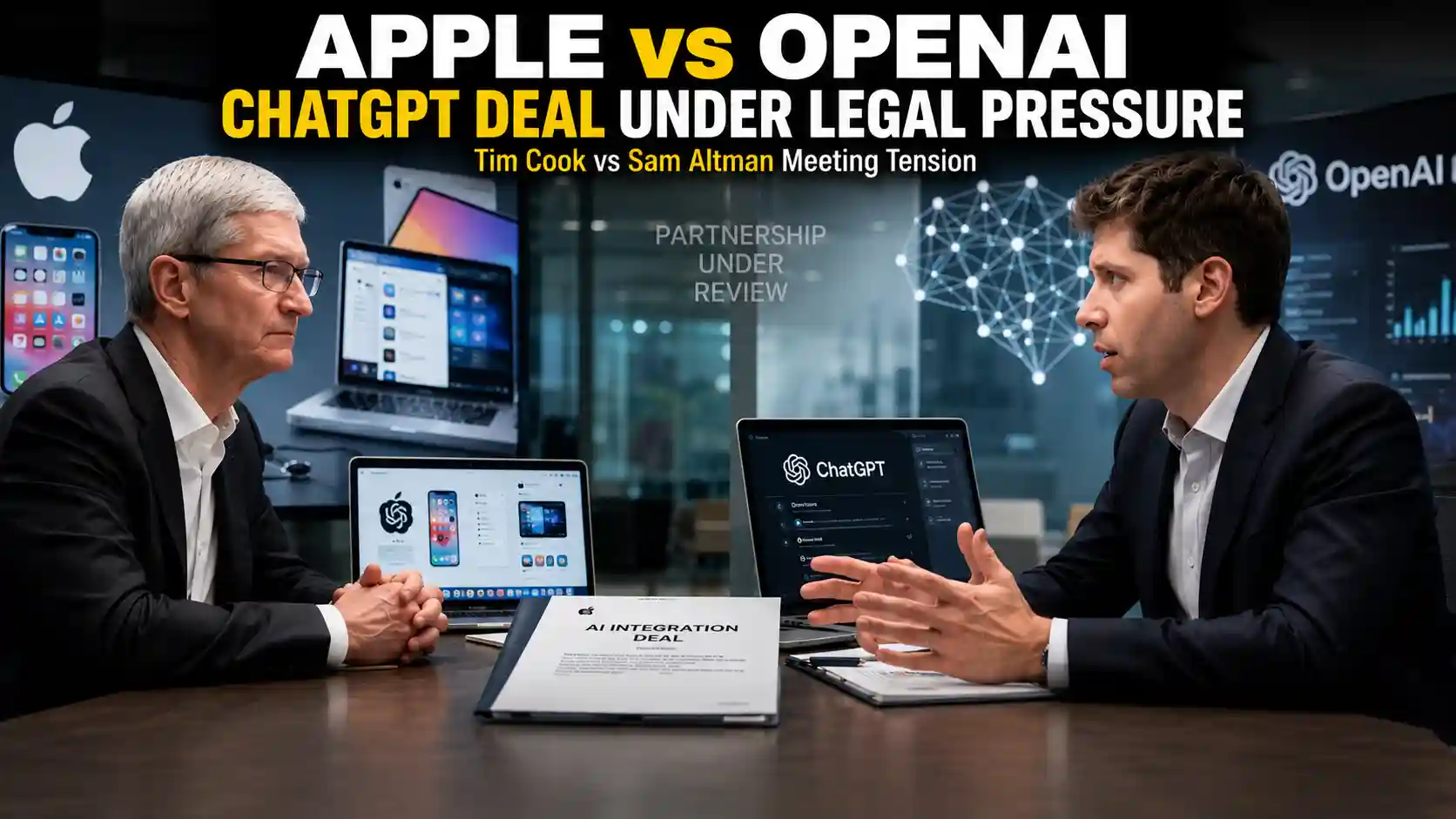
- Apple and OpenAI are reportedly experiencing internal partnership tension
- ChatGPT integration remains central to Apple’s AI strategy
- OpenAI is reviewing long-term benefits of the agreement
- No formal lawsuit has been filed at this stage
- Discussions remain internal and strategic in nature
- Apple has not made any public statement on the issue
- The situation is currently classified as an early-stage disagreement
- Industry and investors are closely monitoring developments
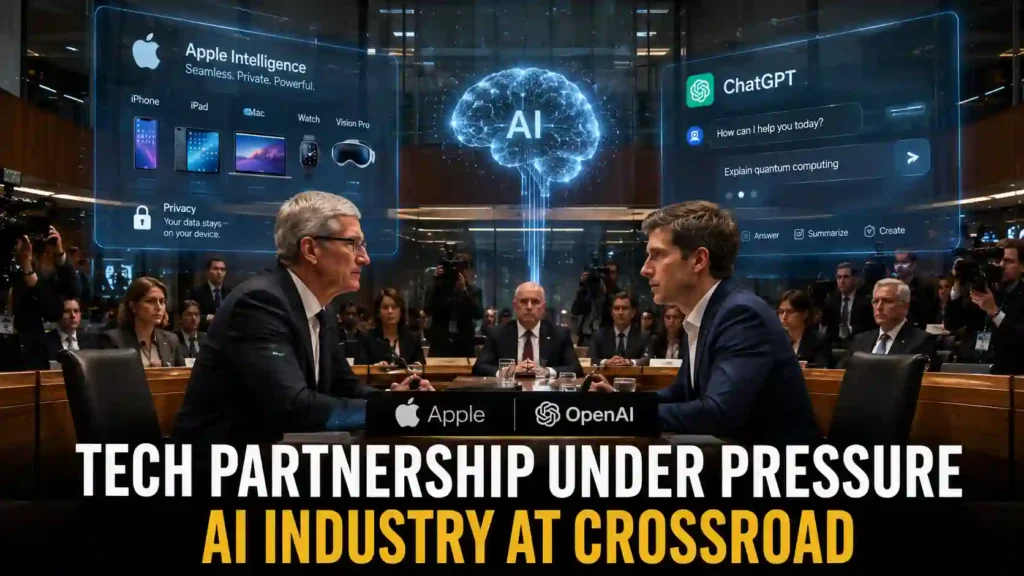
Reports suggest increasing friction between Apple and OpenAI over ChatGPT integration, with internal discussions reportedly exploring possible legal options.
INTRO
Apple and OpenAI’s partnership centered around ChatGPT integration within Apple’s ecosystem is reportedly experiencing growing internal tension. What was initially presented as a strategic collaboration aimed at enhancing artificial intelligence capabilities across Apple devices is now being described in industry reports as a deal facing pressure and internal disagreements.
According to emerging information, OpenAI is reconsidering certain aspects of its arrangement with Apple. The company is reportedly evaluating whether the expected benefits, operational execution, and long-term value align with its strategic goals. While no formal legal case has been filed at this stage, discussions around potential legal actions or contractual remedies are reportedly taking place at an internal level.
This situation has attracted significant attention across the global technology sector. Both Apple and OpenAI are considered key players in shaping the future of consumer artificial intelligence. As a result, any friction between them is being closely monitored by industry analysts, investors, and competitors.
HOW IT STARTED
The collaboration between Apple and OpenAI began with the announcement of ChatGPT integration into Apple’s ecosystem. The goal was to embed advanced generative AI capabilities directly into Apple devices, especially iPhones, making AI tools more accessible to everyday users.
This partnership was widely seen as a major milestone in mainstream AI adoption. It represented a shift where AI would no longer exist as standalone applications but would become deeply integrated into operating systems and user interfaces.
Through this integration, users were expected to access ChatGPT-powered features through Apple’s native system tools. These included enhancements to Siri, writing assistance, summarization tools, and other intelligent system-level functionalities.
Initially, the agreement was perceived as mutually beneficial. Apple gained access to advanced generative AI technology without needing to independently develop large-scale AI models. This allowed Apple to quickly compete in the rapidly evolving AI landscape while maintaining its focus on hardware and ecosystem design.
On the other hand, OpenAI gained massive exposure by integrating its technology into one of the world’s largest consumer device ecosystems. With hundreds of millions of active Apple users globally, the partnership provided OpenAI with a powerful distribution channel that significantly expanded its reach.
However, as the partnership moved from announcement to implementation, certain differences in expectations reportedly began to surface. These differences are believed to be related to monetization strategies, control over user experience, and data usage policies. Over time, these disagreements appear to have contributed to rising internal tension between the two organizations.
MAIN UPDATE / CURRENT DEVELOPMENTS
Recent reports indicate that OpenAI is currently reviewing its partnership with Apple at an internal strategic level. Sources suggest that the company is analyzing whether the existing agreement aligns with its long-term financial goals, product direction, and operational expectations.
Several possible actions are reportedly being considered within internal discussions. These include issuing a formal notice of contract concerns, attempting to renegotiate key terms of the agreement, or exploring legal options as a last resort if negotiations do not produce favorable outcomes.
At this stage, it is important to note that no official lawsuit has been filed, and no public legal proceedings have been initiated. The situation remains in the discussion and evaluation phase rather than escalating into formal legal conflict.
Apple, on the other hand, has not released any public statement regarding the reported tension. The company is known for its approach of handling partnership-related matters privately, often avoiding public commentary until agreements are fully finalized or disputes become formalized.
Industry experts currently describe the situation as an “early-stage commercial disagreement.” This suggests that while there is internal friction, the relationship has not yet broken down into an active legal battle or public conflict.
Analysts also point out that large-scale partnerships in the technology sector often go through phases of renegotiation and adjustment. In many cases, early-stage disagreements are resolved internally without escalating to court-level disputes. situation as an “early-stage commercial disagreement” rather than an active legal battle.
IMPACT ANALYSIS
If the situation between Apple and OpenAI were to escalate further, it could have significant implications for both companies as well as the broader artificial intelligence industry.
Apple has increasingly positioned artificial intelligence as a core component of its ecosystem strategy. Features powered by AI are becoming deeply integrated into iOS, Siri, and other Apple services. The success of these features depends heavily on seamless third-party integrations such as ChatGPT.
For OpenAI, distribution through Apple devices represents a critical growth channel. Mobile platforms are essential for reaching everyday users, and Apple’s global ecosystem provides one of the largest and most valuable user bases in the world. Any disruption in this integration could potentially impact OpenAI’s consumer adoption rate and product visibility.
From an investor perspective, AI partnerships are currently one of the most important drivers of valuation in the technology sector. As a result, any instability in high-profile collaborations such as this one is being closely monitored by markets.
More broadly, the situation highlights the growing complexity of partnerships between AI model providers and major device manufacturers. As AI becomes more embedded in consumer technology, issues related to control, revenue sharing, data ownership, and user experience design are becoming increasingly important.
If unresolved, such disagreements could influence how future AI partnerships are structured across the industry.
FUTURE OUTLOOK
There are several realistic pathways through which this situation may develop over time.
The first and most likely scenario is that both companies resolve their differences through negotiation. In this case, the partnership would continue, potentially with revised terms that better align with both sides’ expectations.
A second possibility is that the agreement is formally revised. This could involve changes to financial arrangements, operational responsibilities, or integration methods. Such adjustments are common in large-scale technology partnerships as both parties refine their collaboration over time.
A third and less likely scenario involves escalation into a formal legal dispute. This would occur only if negotiations fail completely and either party decides that legal action is necessary to protect its interests.
However, most industry analysts believe that a negotiated settlement remains the most probable outcome. This is largely due to the strategic importance of the partnership for both Apple and OpenAI. Maintaining cooperation is likely to be more beneficial than entering a prolonged legal conflict.ome.
CONCLUSION
The reported tension between Apple and OpenAI highlights the challenges involved in integrating advanced artificial intelligence systems into large-scale consumer ecosystems. While the partnership initially represented a major step forward in AI accessibility, evolving expectations and strategic priorities appear to be creating friction between the two companies.
At present, no legal action has been taken, and the situation remains within the scope of internal discussions and evaluations. The final outcome will depend largely on negotiations between the two organizations, both of which have strong incentives to maintain their collaboration.
As artificial intelligence continues to reshape the technology industry, partnerships like this will play a critical role in defining how AI is delivered to billions of users worldwide.