

Read More Article
- AI TODAYS NEWS
- OpenAI Trial Exposed 7 Secrets That Could Change AI Forever
- Microsoft AI Chief Said 18 Months — 3 Months Later Here Is What Actually Happened
- Gates Foundation AI Deal With Anthropic — $200M Confirmed to ChWhy Elon Musk’s OpenAI Trial Exposed 7 Secrets That Could Change AI Forever
- OpenAI Trial Exposed 7 Secrets That Could Change AI Forever
- 3 Historic Moves Confirmed — How Anthropic’s India Strategy Could Change AI Forever in 2026
Table of Contents ( Google I/O 2026 Confirmed )
INTRODUCTION
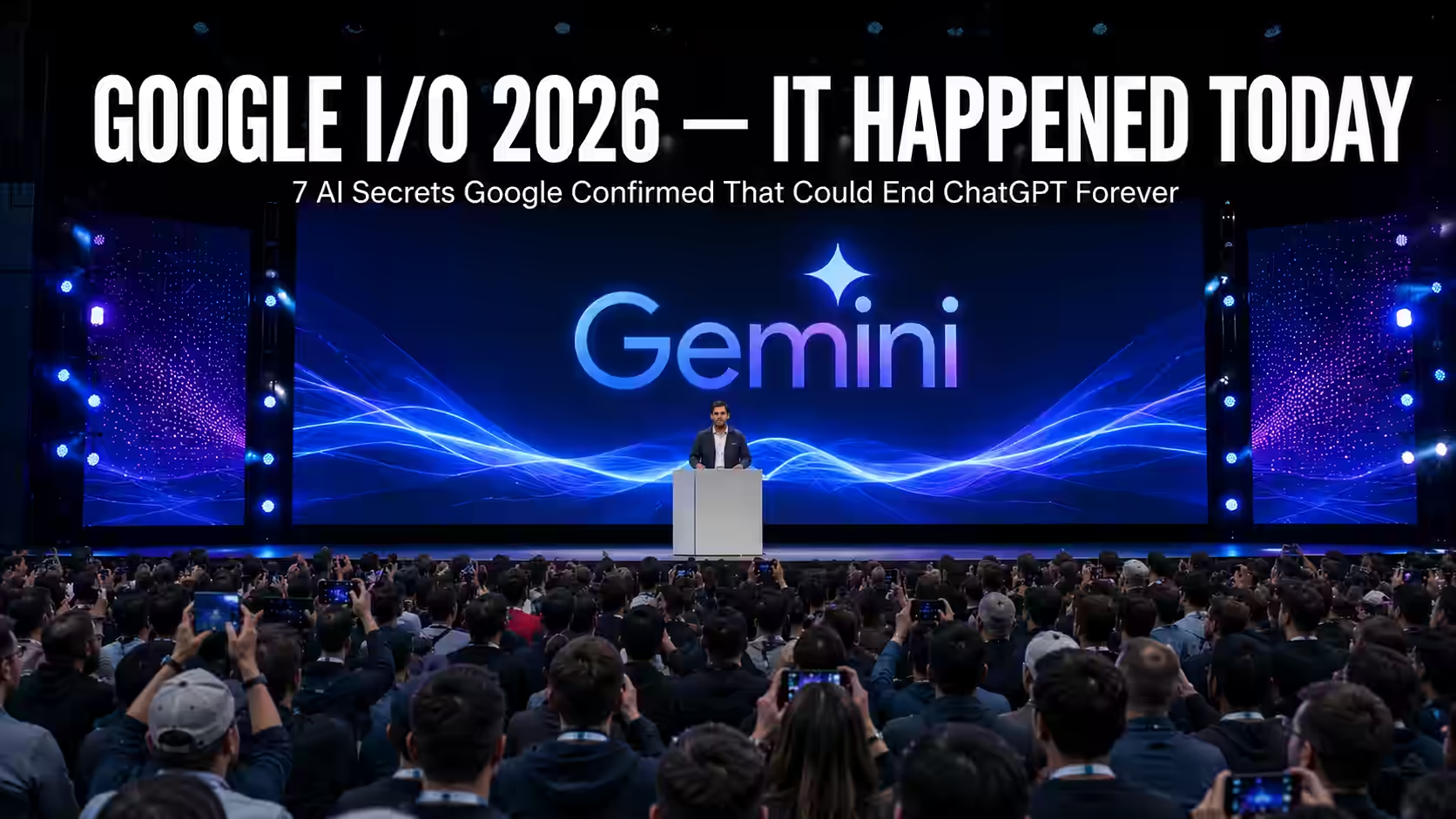
Today, May 19, 2026, Google walked onto a stage in Mountain View, California — and the AI world held its breath.
For months, the question in the technology industry had been building: Can Google actually catch up to OpenAI? After losing ground to ChatGPT for nearly two years, after Sam Altman’s GPT-5.5 redefined what an AI model could do in April, and after Anthropic’s Claude Mythos quietly became the most powerful AI system on the planet — Google had one chance to answer back.
That chance was Google I/O 2026.
What happened over the next two hours at the Shoreline Amphitheatre in Mountain View was not just a product announcement. It was Google’s most aggressive AI moment in years. A new Gemini model. An AI assistant that works across your phone without waiting to be asked. A new laptop category built entirely around AI. Smart glasses. Android that thinks for you.
The full picture of what Google revealed today — and what it means for every person who uses a smartphone, a laptop, or an AI tool — is now clear.
Here is everything that happened, and why it matters.
BACKGROUND
To understand why Google I/O 2026 matters so much, you have to understand how the last two years felt inside Google.
In late 2022, OpenAI launched ChatGPT and the world changed overnight. Google, the company that had invented many of the foundational technologies behind modern AI, suddenly found itself on the back foot. Its own search business — its most valuable asset — was being questioned for the first time in two decades. The word “disruption” was being used not about other industries, but about Google itself.
Google responded. It launched Bard, then Gemini. It merged its two AI research labs — Google Brain and DeepMind — into one giant unit under Demis Hassabis, one of the most respected scientists in the field. It poured billions into compute infrastructure. It launched Gemini 3 in late 2025, which briefly put Google ahead on several key benchmarks and sent OpenAI into what was internally called a “code red” emergency.
But the wins were never quite decisive enough. OpenAI kept pace. Anthropic accelerated past both with Claude Mythos in April 2026 — a model described by independent researchers as redefining what “leading AI” looks like.
By the time Google I/O 2026 arrived on May 19, the company’s position was clear: capable, competitive, but not yet the undisputed leader it once was in technology.
The stakes at this year’s I/O were therefore unusually high. This was not just a developer conference. It was Google making the case — to users, to developers, to investors, and to itself — that it still belongs at the very front of the AI race.
Google’s search revenue grew approximately 19 percent year-over-year to $60.4 billion in Q1 2026, with AI-driven search lifting query volume and improving ad conversion rates. The business is strong. But strength today does not guarantee relevance tomorrow. That is the lesson ChatGPT taught the entire industry.
Today, Google tried to write a different lesson.

MAIN UPDATE
Google I/O 2026 opened its main keynote at 10 a.m. PT on May 19 at the Shoreline Amphitheatre in Mountain View, California.
The announcements came fast.
The first and most significant was the new Gemini model — the centerpiece of the entire event. Multiple reports ahead of the keynote had described the model as landing roughly in the class of OpenAI’s GPT-5.5, which was released on April 24. Independent sources also noted that it would sit below Anthropic’s Claude Mythos, which has reset expectations for what a frontier AI model can do. But being competitive with GPT-5.5 is no small thing. It means Google has closed a meaningful gap in less than twelve months.
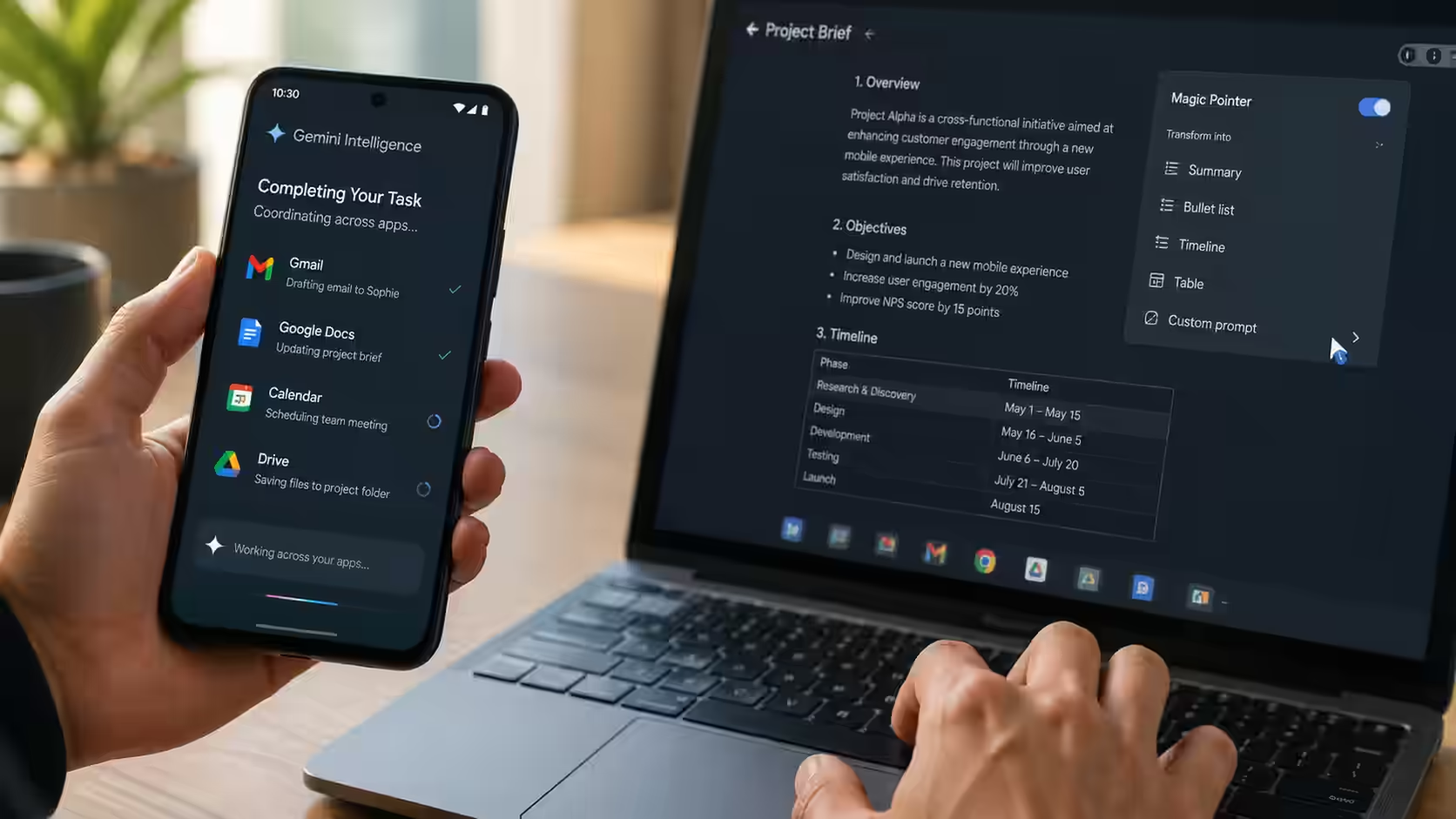
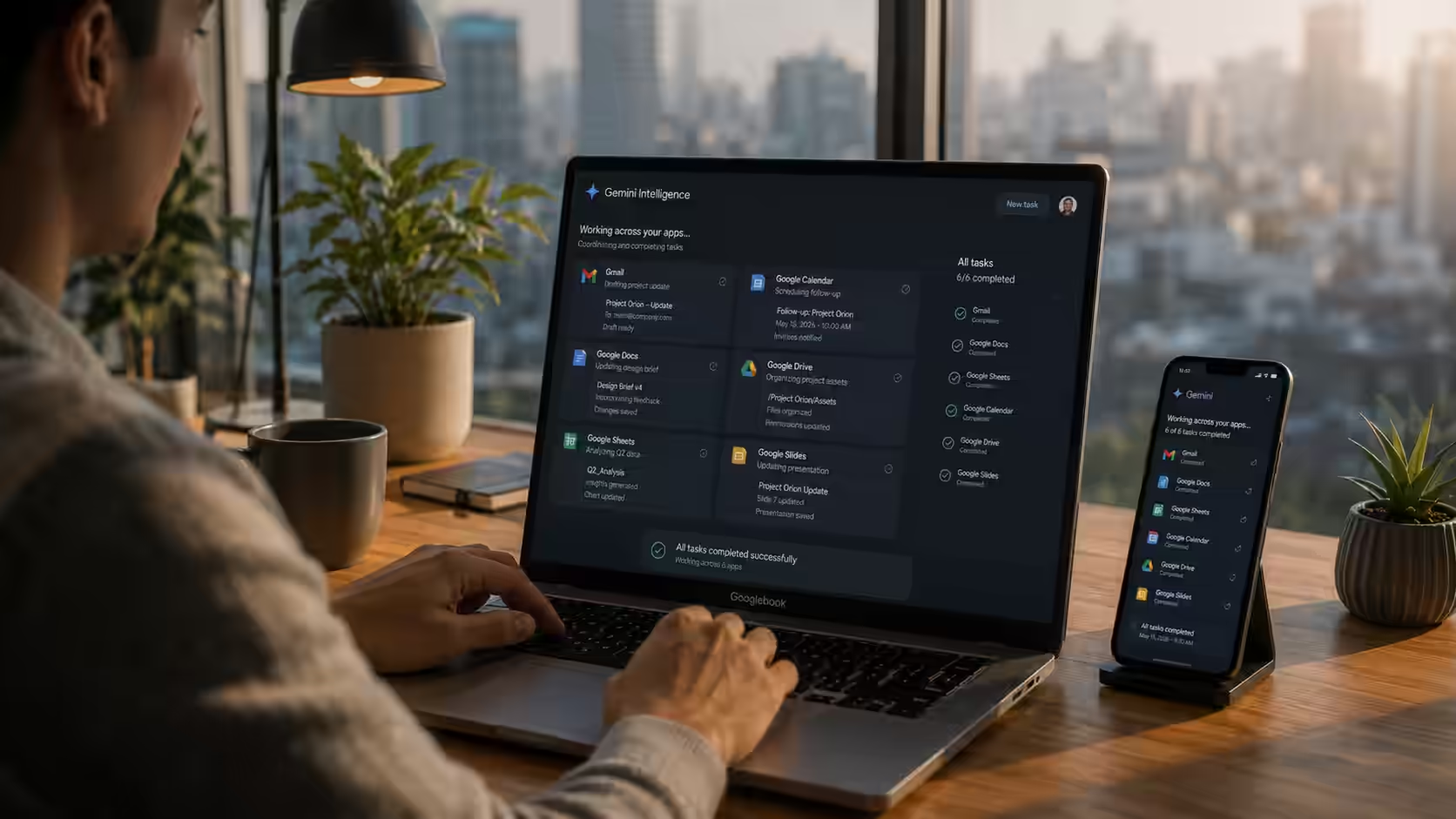
The second major announcement was Gemini Intelligence — Google’s new agentic AI push for Android. This is not a chatbot. It is an AI system that works across your phone, between apps, completing tasks without waiting to be asked. Google showed examples that make the capability concrete. Gemini Intelligence can look at a guest list for an event in your notes, suggest a menu based on food preferences found in your emails, and add items to a shopping cart — all before you have made a single request. It can reserve a parking spot near an event in your calendar. It can lock in a spot at a spin class it noticed you visit every Thursday. Users confirm actions before anything is purchased or posted, but the initiative comes from the AI.
The third major announcement was Googlebooks — an entirely new category of Android-powered laptops from Acer, ASUS, and Lenovo. These are not Chromebooks. They run Android apps natively, support phone app streaming, and are built from the ground up around Gemini AI. A feature called Magic Pointer, built by the Google DeepMind team, activates Gemini-powered suggestions every time you move your mouse cursor. Hover over a date in an email — Gemini suggests creating a meeting. Hover over a product — it compares prices. The first Googlebooks arrive this fall.
The fourth announcement was Android XR smart glasses. Google confirmed it will preview AI-powered eyewear at I/O 2026, built on its Android XR platform. Samsung is a partner, with glasses expected to cost between $379 and $499, developed under the codename “Jinju.” Warby Parker, Gentle Monster, and XREAL are also named as partners, suggesting a range of price points.
The fifth announcement was Gemini in Chrome — now coming to Android. Built on Gemini 3.1, it connects directly to Gmail, Calendar, and Google Keep. Long press a grocery list in your notes — Gemini creates a shopping cart. It is the same AI across every surface Google controls.
The sixth announcement was auto-browsing — a feature that carries out tasks inside your browser without constant prompting. Initially available to AI Pro and Ultra subscribers in the US, it starts rolling out end of June to devices running Android 12 or later.
The seventh, and perhaps most underreported, was Android 17. Google confirmed new scam detection, improved biometric security for lost devices, and deeper Gemini integration throughout the operating system.
IMPACT ANALYSIS
What Google announced today does not just affect tech enthusiasts. It affects anyone who uses a phone, a laptop, or a search engine.
The most immediate impact is on how people interact with their Android devices. Gemini Intelligence is not a feature buried in settings. It is the operating system thinking alongside you — noticing your patterns, your calendar, your emails, and acting on them. For most users, this will feel convenient. For privacy advocates, it raises serious questions that Google has not fully answered. Lindsay Owens, executive director of the consumer economics watchdog Groundwork Collaborative, had already warned in January 2026 that Google’s AI shopping-agent protocol includes “personalized upselling” mechanisms that analyze chat and browsing data. Google disputes the characterization but has not fully addressed the concern for agentic use cases beyond shopping.
For the smartphone market, Googlebooks represents a direct challenge to both Apple’s MacBook and Microsoft’s Copilot+ PC line. If Android-powered laptops gain traction, the competitive dynamics of the entire personal computing industry shift. Apple’s WWDC 2026, expected to preview iOS 27 and a smarter Siri, now faces a more urgent competitive backdrop.
For OpenAI, today’s announcements mean GPT-5.5’s advantage is narrower than it was yesterday. A competitive Gemini model connected to the world’s most widely used search engine, email service, and Android ecosystem is a different kind of competitor than a standalone chatbot.
For developers, Google’s agentic AI tools and the new Interactions API — which allows developers to embed Gemini Deep Research capabilities into their own apps — represent a significant new opportunity. The question is whether Google’s ecosystem will attract the same developer energy that OpenAI has built around ChatGPT.

FUTURE OUTLOOK
Google I/O 2026 has set the agenda for the next twelve months of the AI industry.
The competition between Google, OpenAI, and Anthropic has entered what may be its most consequential phase yet. Each of the three companies now has a credible frontier model. Each has a different strategy for how AI reaches users — OpenAI through ChatGPT and the API, Anthropic through enterprise and safety-focused deployments, Google through its owned ecosystem of Search, Android, Chrome, Gmail, and Maps.
The ecosystem advantage is Google’s most durable competitive edge. A billion Android users will receive Gemini Intelligence updates this summer without downloading a separate app or paying for a subscription. That distribution scale is something OpenAI cannot match through ChatGPT alone.
But distribution is not the same as trust. Google’s data practices have faced regulatory scrutiny in Europe, India, and the United States. An AI system that reads your emails, monitors your calendar, and acts on your browsing history is a qualitatively different data relationship than a search engine. How users respond to Gemini Intelligence in practice — whether they embrace the convenience or disable the permissions — will determine whether today’s announcements translate into lasting market dominance.
For consumers watching today’s keynote, the practical question is simpler: should you switch from iPhone to Android, from ChatGPT to Gemini, from a MacBook to a Googlebook?
Not yet. The products announced today are previews — most arrive in late summer or fall 2026. But the direction is clear. Google is no longer playing catch-up. It is building something that no single competitor can fully replicate: an AI that is already inside every product you already use.
Whether that is an advantage or a concern depends on how much you trust the company building it.
EXPERT INSIGHTS
- Google (Official I/O 2026 announcement): Gemini Intelligence will first appear on the latest Samsung Galaxy and Google Pixel phones and begin rolling out this summer, with auto-browsing available to AI Pro and Ultra subscribers in the US from end of June.
- Multiple sourced reports ahead of I/O (confirmed May 18-19, 2026): The new Gemini model announced today lands roughly in the class of OpenAI’s GPT-5.5 — a significant competitive move, though independent analysis suggests it sits below Anthropic’s Claude Mythos in benchmark performance.
- Lindsay Owens, Groundwork Collaborative (January 2026): Warned that Google’s AI shopping-agent protocol includes “personalized upselling” mechanisms that analyze chat and browsing data — a concern that now extends directly to Gemini Intelligence’s agentic capabilities.
- Google Search revenue data (Q1 2026): Search revenue grew approximately 19% year-over-year to $60.4 billion, with AI-driven search lifting both query volume and ad conversion rates — confirming that AI is already converting to revenue at Google in a way it has not yet at OpenAI.
- Android Authority pre-I/O analysis (May 2026): Described I/O 2026 as potentially “one of Google’s most ambitious events in years” — citing Gemini Intelligence, Googlebooks, Android XR glasses, and major Gemini model updates as a convergence of long-term bets arriving simultaneously.
- TechTimes analysis (May 19, 2026): Noted that the new Gemini model will be “measured against GPT-5.5 and Anthropic’s Claude Mythos from the moment the keynote ends” — framing I/O 2026 as a direct competitive response to both rivals, not just OpenAI.
- eWeek pre-event report (May 2026): Reported urgency inside Google to improve coding capabilities as competitors have pulled ahead, particularly as Claude Code and OpenAI’s Codex gain traction outside traditional engineering circles.
KEY TAKEAWAYS
- Google I/O 2026 opened today, May 19, at the Shoreline Amphitheatre in Mountain View — the keynote began at 10 a.m. PT and is streaming live globally on YouTube.
- Google confirmed a new Gemini model that competes directly with OpenAI’s GPT-5.5, released April 24 — closing a meaningful performance gap in under twelve months.
- Gemini Intelligence is Google’s new agentic AI for Android — it works across your phone between apps, completing tasks proactively based on your emails, calendar, and usage patterns, with user confirmation before any purchases or sensitive actions.
- Googlebooks is a new category of Android-powered AI laptops from Acer, ASUS, and Lenovo — arriving this fall, built around Gemini AI with a feature called Magic Pointer that activates AI suggestions based on cursor movement.
- Google confirmed Android XR smart glasses at I/O 2026 — Samsung is a key partner, with glasses expected between $379 and $499, alongside Warby Parker, Gentle Monster, and XREAL partnerships.
- Gemini in Chrome arrives on Android, built on Gemini 3.1, with direct connections to Gmail, Calendar, and Google Keep — auto-browsing capability rolls out end of June to Android 12 devices.
- Google’s ecosystem advantage is its most powerful competitive weapon — one billion Android users will receive Gemini Intelligence updates this summer without downloading anything new.
- Privacy concerns around agentic AI remain unresolved — consumer advocates have warned that AI systems reading emails and monitoring calendars represent a qualitatively different data relationship than traditional search.
CONCLUSION
Today, May 19, 2026, Google answered the question the industry has been asking for two years.
Can it compete?
The answer from I/O 2026 is yes — and on some fronts, it is now leading. A new Gemini model. AI that thinks across your entire phone. Laptops built from the ground up around AI. Smart glasses. A browser that works for you without waiting to be asked.
OpenAI has ChatGPT. Anthropic has Claude Mythos. Google now has something different — an AI strategy embedded inside products that one billion people already use every single day.
What do YOU think — is Google finally ready to take the AI crown from OpenAI? Drop your thoughts below. Share this with one person who needs to know what happened today. Follow AI Today’s News to stay ahead every day.