

Table of Contents ( Google Blackstone )
INTRODUCTION
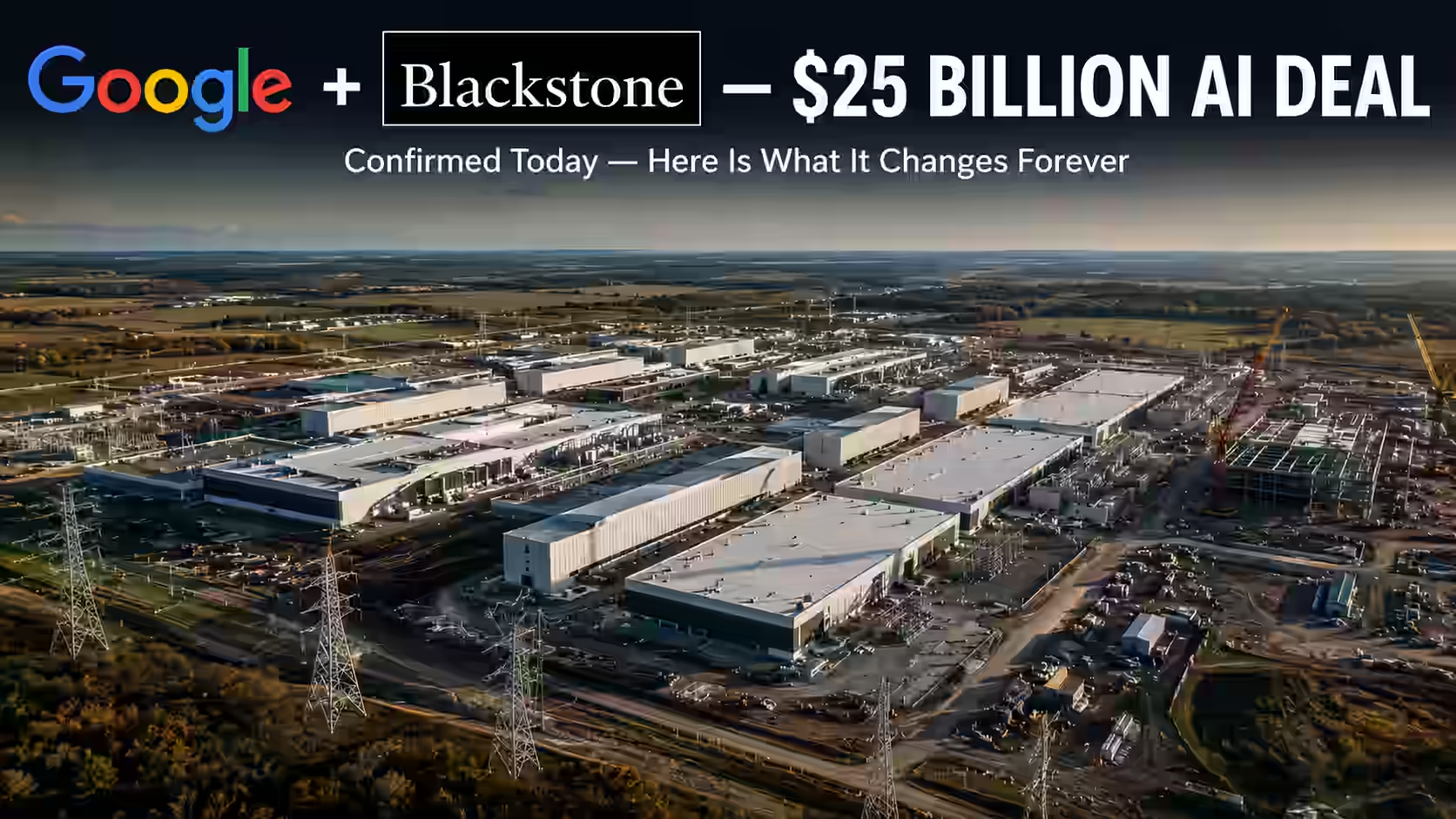
The number that landed this morning was $25 billion.
Not a valuation. Not a projection. A committed investment — announced today, May 18, 2026 — by two of the most powerful names in global finance and technology. Google and Blackstone have formed a joint venture to build AI cloud infrastructure at a scale the industry has rarely seen outside of the largest tech companies themselves.
Blackstone, the world’s largest alternative asset manager with over $1.3 trillion under management, is putting in an initial $5 billion in equity. Google is bringing its most advanced AI chips — custom-built processors that power some of the world’s most sophisticated AI models. Together, they are building something that does not yet have a public name but already has a CEO, a timeline, and a clear target: 500 megawatts of data centre capacity online by 2027.
The announcement came just hours before Google I/O 2026 — the company’s biggest annual event — begins tomorrow. The timing was not an accident. This is Google telling the world that its AI ambitions do not stop at software.
Here is what happened, why it matters, and what it means for the future of artificial intelligence.
Also Read…. >> Google I/O 2026 Confirmed 7 AI Secrets Against ChatGPT.
BACKGROUND
To understand why this deal exists, you have to understand the problem it is solving.
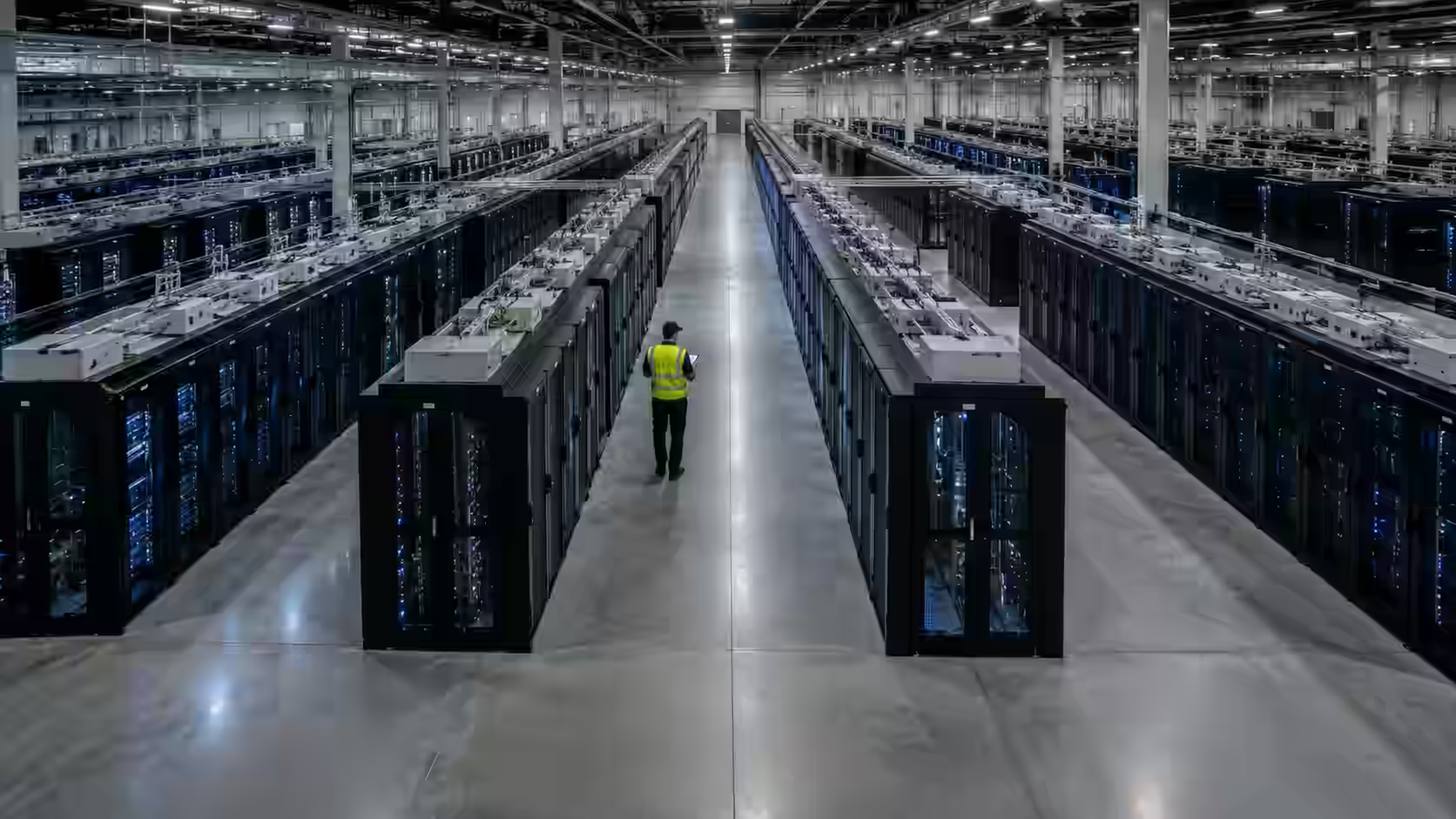
Artificial intelligence runs on compute. Not software, not algorithms — physical hardware. Specifically, it runs on chips that process vast quantities of data simultaneously, inside buildings that consume as much electricity as a small city, cooled by industrial systems that require enormous quantities of water and land.
For the past several years, the race in AI has been framed as a race between models — ChatGPT versus Gemini versus Claude. That framing is not wrong. But it misses the deeper constraint that every serious participant in the AI industry is now confronting. You cannot run a frontier AI model without the physical infrastructure to support it. And that infrastructure is becoming one of the most valuable and contested resources in the global economy.
Big Tech companies recognised this early. Microsoft committed $80 billion to AI infrastructure in 2025. Amazon announced $100 billion in capital expenditure the same year. Google’s own filings show it spent $91.4 billion on capital expenditure in 2025, primarily for technical infrastructure — nearly double its spending in 2024. And in its most recent investor communications, Google stated it expects to increase that figure again significantly in 2026.
The problem is that building data centres at scale is not just a capital challenge. It is a real estate challenge. An energy challenge. A permitting and construction challenge. These are not areas where technology companies have traditionally excelled.
Blackstone, on the other hand, has spent decades building expertise in exactly these areas. It is the largest global provider of data centres by some measures. Its Digital Infrastructure Trust raised $1.75 billion in a U.S. IPO just five days ago, on May 13, 2026, focused specifically on newly constructed data centres. The firm has turned physical infrastructure into one of its highest-returning asset classes. It understands land, power, cooling, and construction in ways that even the largest technology companies do not.
The Google-Blackstone venture is a recognition that the next phase of AI will be won or lost not in a research lab, but in how quickly and efficiently you can build the physical systems that make AI work.
Spending by Big Tech firms on AI infrastructure is expected to top $700 billion in 2026 alone. That number, by itself, explains why Blackstone is here.
Also Read…. >> ChatGPT Wrongful Death Lawsuit 2026: 3 Shocking Secrets Exposed That Killed a 19-Year-Old
MAIN UPDATE
The announcement came this morning through official press releases from both Blackstone and Google, confirmed by Reuters and Bloomberg.
The structure of the deal is straightforward but significant.
Blackstone will be the majority owner of the new company. It is committing an initial $5 billion in equity capital from its managed funds — with plans, according to Bloomberg, for the total investment to reach $25 billion including leverage over time. The company will bring its first 500 megawatts of data centre capacity online in 2027, with expansion planned beyond that.
Google’s role is equally important. It will supply hardware — specifically its Tensor Processing Units, or TPUs. These are custom-designed chips that Google has spent years developing specifically for AI workloads. They are optimised for both training and running advanced AI models, and have historically only been accessible through Google Cloud directly. The new venture changes that. For the first time, companies will be able to access Google’s TPUs outside of Google Cloud — through the new joint company, as a compute-as-a-service offering.
Google will also provide software and services, and its technical expertise in building and operating AI infrastructure at scale.
The new company already has a leader. Blackstone has named Benjamin Treynor Sloss as CEO — a Google executive with over two decades of experience building and operating Google’s global infrastructure. He is, by background, one of the most qualified people in the world to run exactly this kind of operation.
Jon Gray, President and COO of Blackstone, did not use understated language when describing the deal. “We see a generational opportunity to invest capital at scale building AI infrastructure,” he said in the official announcement. “This new company has enormous potential as it helps to meet the unprecedented demand for compute.”
Thomas Kurian, CEO of Google Cloud, framed Google’s contribution around the unique nature of its chips. TPUs, he said, are “optimised for efficiency in the AI era” — a claim supported by multiple independent benchmarks that have shown Google’s TPUs performing competitively with Nvidia’s industry-dominant GPUs on many AI workloads at lower energy costs.
The venture’s timing — announced the evening before Google I/O 2026 — reflects a deliberate strategy. Google is not just announcing new AI features tomorrow. It is announcing that it is building the physical foundation for AI at a scale that few competitors can match.
What this new company will be called has not yet been disclosed. Its headquarters will be in the United States. And its first test will be whether 500 megawatts of capacity can genuinely be online by 2027 — a timeline that, in the data centre industry, is considered aggressive.
Also Read…. >> Microsoft AI Chief Said 18 Months — 3 Months Later Here Is What Actually Happened

IMPACT ANALYSIS
The Google-Blackstone deal has implications that stretch well beyond the two companies involved.
For companies that need AI compute, this creates a new option. Today, if you want to run large-scale AI workloads on Google’s TPUs, you must do so through Google Cloud directly. The new venture changes that model. A company that does not want to be locked into Google Cloud — but still wants access to Google’s chips — will now have an alternative path. This is, in the language of enterprise technology, a significant increase in customer choice.
For Nvidia, which currently supplies the dominant share of AI chips globally, the announcement is a signal worth watching carefully. Google has consistently claimed its TPUs deliver competitive or superior performance per watt compared to Nvidia’s GPUs on many AI tasks. If a $25 billion venture backed by Blackstone’s distribution and capital capabilities begins marketing TPU-based cloud services aggressively, it will create the most credible large-scale alternative to Nvidia-centric infrastructure that the market has seen.
For the data centre industry, the deal confirms that physical AI infrastructure has become one of the most sought-after asset classes in global finance. Blackstone is not a technology company. It is the world’s largest alternative asset manager. The fact that it is building data centres and selling AI compute is a signal about where institutional money sees the highest returns in the next decade.
For ordinary technology users, the impact is indirect but real. AI services cost money to run. The more efficiently that compute can be delivered — through optimised chips, specialised infrastructure, and competitive market options — the lower those costs will eventually become. Increased competition in AI infrastructure is, over time, good for anyone who uses AI tools.
The single concern that analysts have already raised is concentration. Google is now simultaneously the provider of AI models, the operator of the world’s most used search engine, a cloud provider, and — through this new venture — a chip supplier to a separately capitalised infrastructure company that it significantly influences. Regulators in Europe and the United States, who are already examining AI market concentration, will be watching the structure of this deal carefully.
Also Read…. >> OpenAI Trial Exposed 7 Secrets That Could Change AI Forever
FUTURE OUTLOOK
The Google-Blackstone venture is not a one-time announcement. It is the opening move in what is likely to become a much larger restructuring of how AI infrastructure is owned and operated globally.
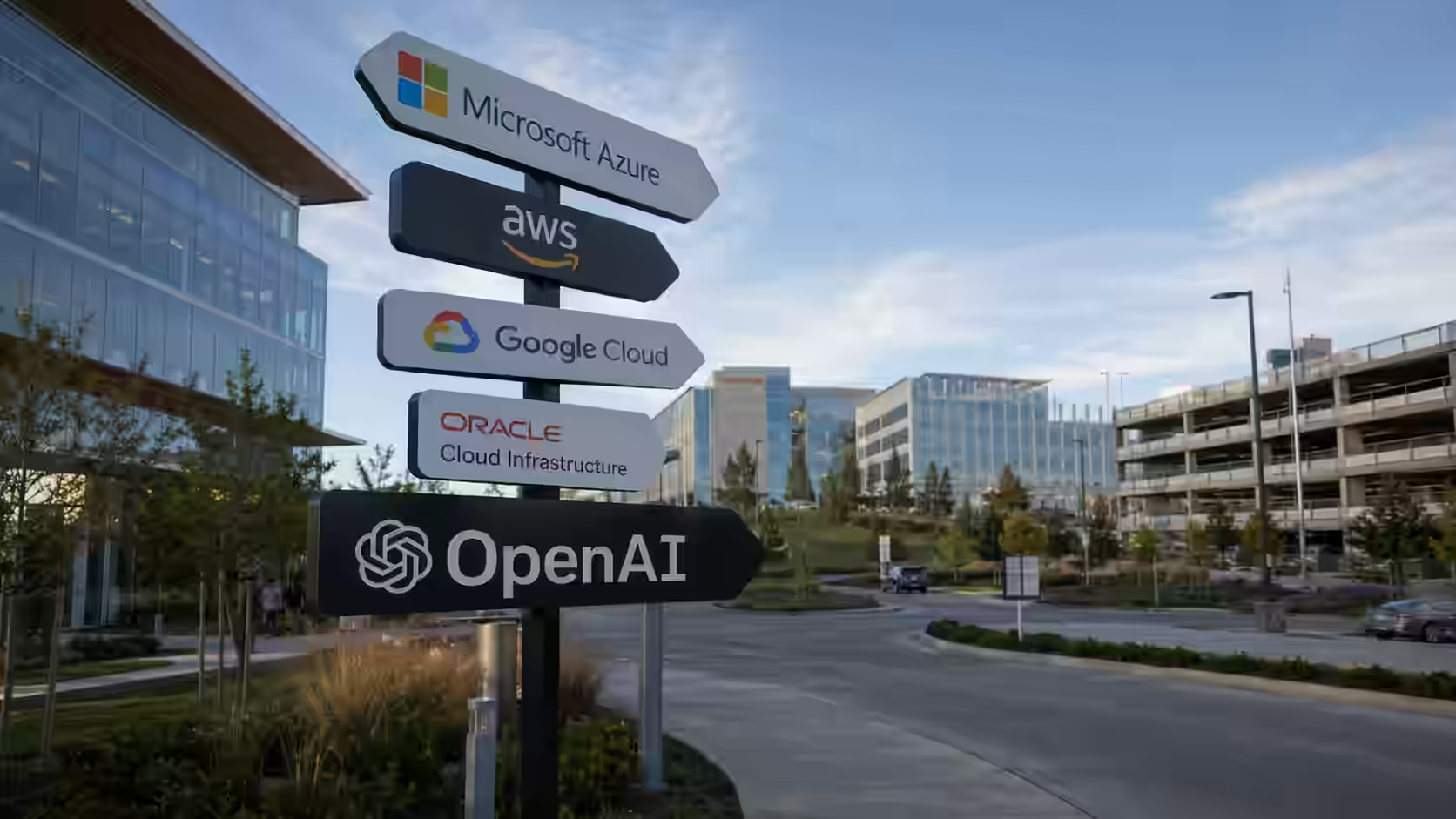
The pattern is already visible. Microsoft has Azure and its own data centre buildout, backed in part by OpenAI’s commercial success. Amazon has AWS, the market leader in cloud infrastructure. Both companies have been investing in their own AI chip development — Amazon with Trainium and Inferentia, Microsoft with its Maia chips. Google has TPUs. All three are racing not just to build better models, but to control the physical layer that models run on.
The Blackstone partnership represents a different model. Rather than Google building and owning all the infrastructure itself — which requires enormous capital and diverts focus from product development — the venture offloads the capital intensity to a financial partner with deep expertise in real assets. Google gets wider distribution for its chips. Blackstone gets returns from one of the highest-demand asset classes in the world. The arrangement is likely to be studied and replicated.
Looking ahead, the question for this specific venture is execution. Bringing 500 megawatts of data centre capacity online by 2027 requires securing power agreements, construction permits, and cooling infrastructure across multiple sites, simultaneously, at a pace that the industry has rarely sustained. The data centre construction pipeline in the United States is already strained — land near power substations is limited, permitting timelines are long, and the workforce to build these facilities is not infinitely scalable.
If the venture delivers on its 2027 timeline, it becomes a template. If it falls behind, the conversation will shift to whether AI infrastructure ambitions have outpaced the physical world’s ability to support them.
Either outcome tells you something important about where AI is heading.
Also Read…. >> CEO Deleted The ChatGPT Chat — The Same Deleted Chat Exposed Him In Court
EXPERT INSIGHTS
- Jon Gray, President and COO of Blackstone (official announcement, May 18, 2026): “We see a generational opportunity to invest capital at scale building AI infrastructure. This new company has enormous potential as it helps to meet the unprecedented demand for compute. We are incredibly proud to partner with Google — bringing together their world class TPUs and AI capabilities with Blackstone’s exceptional strength in energy and digital infrastructure.”
- Thomas Kurian, CEO of Google Cloud (official announcement, May 18, 2026): Said Google’s TPUs are “optimised for efficiency in the AI era” and that the partnership would “rapidly accelerate” access to high-performance AI compute for companies that need it.
- Benjamin Treynor Sloss, named CEO of the new venture (Blackstone press release, May 18, 2026): A Google executive with over two decades of experience building and operating Google’s global infrastructure — described by Blackstone as uniquely positioned to lead a company at the intersection of financial capital and technical infrastructure.
- Reuters / Bloomberg (May 18, 2026): Reported the total investment value could reach $25 billion including leverage — a figure neither company confirmed or denied publicly. Big Tech spending on AI infrastructure is expected to top $700 billion globally in 2026.
- Prism News analysis (May 18, 2026): Noted that “Blackstone and Google are betting $5 billion that AI’s real bottleneck is not software but the power, land and cooling needed to run it” — framing the deal as a direct response to the physical constraints now limiting AI deployment speed.
- Blackstone Digital Infrastructure Trust (May 13, 2026): Raised $1.75 billion in a U.S. IPO just five days before the Google deal was announced — confirming that Blackstone had already established a dedicated financial vehicle for data centre assets before this venture was made public.
Also Read…. >> Gates Foundation AI — $200M Anthropic Deal Confirmed 2026
KEY TAKEAWAYS
- Google and Blackstone announced a joint AI cloud venture today, May 18, 2026 — one of the largest AI infrastructure deals announced in a single day this year.
- Blackstone is committing an initial $5 billion in equity, with total investment potentially reaching $25 billion including leverage, according to Bloomberg.
- The new company will bring 500 megawatts of data centre capacity online in 2027 — a timeline considered aggressive by industry standards.
- For the first time, Google’s custom AI chips — Tensor Processing Units, or TPUs — will be available outside of Google Cloud directly, through this new venture’s compute-as-a-service model.
- Benjamin Treynor Sloss, a Google executive with over 20 years of infrastructure experience, has been named CEO of the new company.
- Blackstone will be the majority owner of the venture. Google will supply hardware, software, and services.
- Big Tech spending on AI infrastructure is expected to top $700 billion globally in 2026 — this venture is a direct response to that demand.
- The deal positions Google as not just an AI model provider but a chip distributor and infrastructure architect — a significant expansion of its role in the AI supply chain.
Also Read…. >> Anthropic India’s CEO Revealed 5 Predictions That Could Change India Forever by 2030
CONCLUSION
Today’s announcement is not about two companies making money together.
It is about who controls the physical layer of artificial intelligence.
AI is not just software. It is chips, power, land, cooling systems, and fibre cables. It is buildings the size of city blocks running twenty-four hours a day. It is one of the most capital-intensive industries in human history, growing faster than almost any industry that has come before it.
Google and Blackstone are betting $25 billion that the bottleneck in AI’s next chapter is not a better model — it is the infrastructure to run it.
Whether they are right will become clear in 2027, when the first 500 megawatts come online.
What do YOU think — will this give Google the edge it needs over OpenAI and Amazon? Drop your thoughts below. Share this with one person who works in technology or finance. Follow AI Today’s News to stay ahead every day.