

Table of Contents ( Dario Amodei Predictions )
INTRODUCTION
Most tech CEOs talk in possibilities. Dario Amodei talks in timelines.
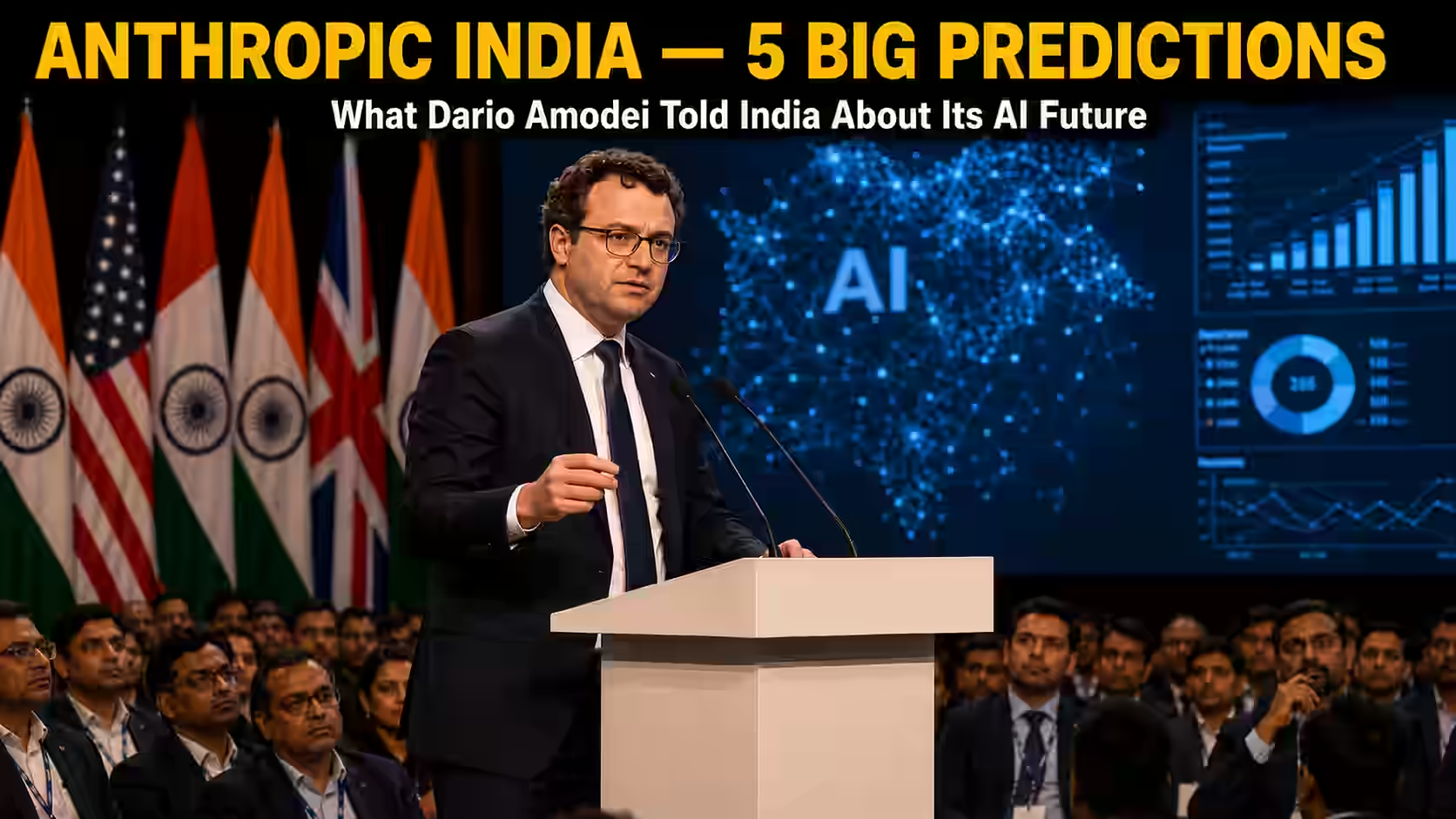
At the India AI Impact Summit 2026 in New Delhi, the CEO of Anthropic stood in front of a room full of India’s sharpest minds and said something that very few people in his position ever say out loud. He told them that India could see economic growth of 20 to 25 percent because of AI. He told them that software engineers could be replaced within months. And he told them that AI will surpass human intelligence within a few years.
That is not the kind of statement you forget.
Amodei has been building toward this moment for years. First came his October 2024 essay. Then his Davos 2026 appearances. Then a 20,000-word essay published in January 2026. And finally, his arrival in India — where he said, without hesitation, that this country may benefit from AI more than any other nation on earth.
Here are the five predictions he made. And why every person in India should be paying close attention right now.

BACKGROUND — The Man Behind the Predictions
Not every prediction deserves equal weight. But when Dario Amodei speaks, the AI industry listens — and for good reason.
Amodei is not a typical startup founder chasing headlines. He holds a PhD in computational neuroscience from Princeton University. Before founding Anthropic, he served as Vice President of Research at OpenAI, where he personally led the development of GPT-2 and GPT-3 — the models that launched the generative AI era that the entire world is now living inside.
In 2021, he left OpenAI with his sister Daniela Amodei and a group of senior researchers. The reason was not money. It was a fundamental disagreement about how seriously safety needed to be taken as AI grew more powerful. They founded Anthropic with one mission: build the most capable AI in the world, and do it safely.
That mission has paid off. Anthropic grew from zero revenue in early 2023 to approximately $9 billion by the end of 2025. In 2026, projections put that number between $20 and $26 billion. The company now serves over 300,000 business customers. Around 80 percent of its revenue comes from enterprise clients. It employs more than 4,000 people.
In December 2025, Menlo Ventures confirmed that Anthropic had overtaken OpenAI as the leader in enterprise AI — accounting for around 40 percent of enterprise large language model spending globally.
This is the man who flew to India and made five predictions about what AI will do to this country over the next five years.
In October 2024, he published “Machines of Loving Grace” — a sweeping essay about how AI could transform human civilization. Then, on January 26, 2026, he followed it with “The Adolescence of Technology” — a 20,000-word document outlining the five biggest existential risks that powerful AI now poses to the world.
These were not marketing materials. These were warnings from someone who builds the technology himself.

MAIN UPDATE — The 5 Predictions Amodei Made for India
Prediction 1 — India Could See 20 to 25 Percent Economic Growth
This one stopped the room.
Speaking at the India AI Impact Summit 2026 at Bharat Mandapam in New Delhi, Amodei said that while advanced economies — Europe, the US, Japan — might see around 10 percent growth from AI deployment, India could theoretically reach 20 to 25 percent.
The reason is not complicated, but the implication is enormous. India is what economists call a catch-up economy. It has room to grow that developed nations no longer have. AI, Amodei argued, could compress decades of that growth into a handful of years.
“I think in the global south, there’s an opportunity for AI to accelerate catch-up growth, to solve a bunch of problems that are in the way of catch-up growth,” he said during a fireside conversation alongside Nandan Nilekani, the co-founder of Infosys and the architect of India’s Aadhaar identity system.
He called India a “perfect case study” for AI-led growth. He was careful to add that reaching those numbers would require the right collaboration between developers, researchers, and policymakers. But the number itself — 20 to 25 percent — had already landed.
Prediction 2 — AI Will Surpass Human Intelligence Within a Few Years
Amodei used a phrase at the summit that most CEOs would never say in public. He described the near future as the age of “a country of geniuses in the data center.”
He warned that AI is rapidly approaching human-level cognitive abilities — not in one narrow task, but across the full range of intellectual work. Research, reasoning, writing, coding, scientific discovery. All of it.
He had written in his October 2024 essay that powerful AI could arrive “as early as 2026.” By the time he spoke in India in February 2026, that window had tightened considerably.
Prediction 3 — Software Engineers Could Be Replaced in 6 to 12 Months
This is the prediction that hit closest to home for India’s technology industry.
At Davos in January 2026, Amodei said that AI could replace software engineers within six to twelve months. He was not talking about junior developers losing small tasks. He was talking about the core function of writing, debugging, and deploying code — at scale, without human intervention.
India has one of the largest concentrations of software engineers in the world. Millions of people whose careers were built on exactly the skills Amodei was describing.
He did not soften this message for the Indian audience. He repeated it. And he added that the builders who survive will be the ones who stop building for what AI can do today, and start building for what it will be able to do in one or two years from now.
“Don’t build for step four out of a ten-step workflow,” he said. “Try and do the whole workflow, even if the AI model isn’t quite capable of it yet.”
Prediction 4 — 50 Percent of White-Collar Jobs Will Be Disrupted in 1 to 5 Years
In his January 2026 essay “The Adolescence of Technology,” Amodei wrote that AI could displace up to 50 percent of entry-level white-collar jobs within one to five years. He warned of wealth concentration exceeding that of the Gilded Age, with personal fortunes potentially reaching into the trillions of dollars.
For India, this lands differently than it does for the United States. India’s services economy — the call centers, the BPO industry, the IT outsourcing sector — is built on exactly the kind of white-collar knowledge work that AI is now beginning to perform faster, cheaper, and without rest.
Amodei acknowledged this directly. “The upside is huge,” he said at the summit. “But we must prepare for the shifts AI will bring.”
Prediction 5 — India Has an “Absolutely Central Role” in Global AI Governance
This was perhaps the most important prediction of all — because it was also a responsibility.
Amodei said India has an “absolutely central role” to play in shaping how AI develops globally. Not just in using the technology, but in governing it. In setting standards. In making decisions that will affect the rest of the developing world.
India is the world’s largest democracy. It has a proven track record of building digital public infrastructure — UPI, Aadhaar, DigiLocker — that other countries are now trying to replicate. And it has a government that, by Amodei’s own account, moves faster on technology adoption than almost any government he has seen.
“How India deploys AI across critical sectors like education, healthcare, and agriculture for over a billion people will be essential in shaping the future of AI,” he had said after his meeting with PM Modi in October 2025.
He repeated that message in February 2026. The position has not changed.

IMPACT ANALYSIS — What These Predictions Mean for Real People
The short-term impact is already measurable.
India’s IT outsourcing industry is under pressure it has not felt in decades. TCS and Wipro both reported weak revenue growth in early 2026. Investors are shifting attention away from traditional IT services and toward AI-native companies. The model of sending human labor to do knowledge work that Western companies need — the model that built India’s $300 billion technology industry — is being stress-tested in real time.
For individual developers, the picture is more nuanced. Anthropic’s own data shows that Claude usage in India is growing faster than anywhere else on the planet. Indian developers are not being left behind — many of them are leading the adoption. Claude Code usage in India grew five times between June and October 2025 alone. That is not a market that is falling behind. That is a market that is running toward the technology.
The agriculture and healthcare sectors tell a different story. Amodei specifically mentioned these two areas as places where AI could compress decades of progress. India has over 600 million people connected to agriculture in some form. AI-powered crop analysis, market prediction, and resource optimization tools are already being piloted. If Amodei’s growth projections hold, the impact on rural India could dwarf anything the IT boom delivered.
The risk side, however, is real. Amodei identified five existential AI risks in his January 2026 essay. Among them: autonomous AI misalignment, biological misuse of AI tools, and economic disruption at a scale that could destabilize entire labor markets. For a country with India’s population and economic diversity, the disruption scenario is not abstract. It is a policy challenge that requires immediate preparation.

FUTURE OUTLOOK — What India Must Prepare For
The next five years are not going to arrive gradually. That is the core of Amodei’s message, and it is worth sitting with for a moment.
Most technological shifts happen slowly enough that economies and education systems can adapt. The industrial revolution took generations. The internet took two decades to fully reshape the workforce. AI, according to Amodei and an increasing number of researchers, is not following that pattern.
By 2028, Amodei has predicted that AI will reach Nobel-level scientific research capability. That means AI systems capable of making original discoveries in biology, chemistry, physics, and medicine — not assisting human researchers, but independently generating new knowledge.
For India, this creates a specific opportunity window. The country’s investment in AI education, research infrastructure, and governance frameworks over the next two to three years will determine whether India captures the upside of this shift or absorbs the disruption.
Anthropic is already moving on the education front. The Gates Foundation partnership announced on May 14, 2026, commits $200 million toward AI-powered literacy and numeracy tools for Indian children, built in Hindi and ten other Indian languages. This is not a vague commitment — it is a specific infrastructure build that will affect millions of students within the next four years.
The government’s role will be critical. Amodei has praised India’s government for moving faster on AI adoption than almost any other he has observed. The Ministry of Statistics building a specialized Claude-powered server for economic data queries — a fact Amodei cited directly — is a signal that institutional India is not waiting.
What individual professionals, students, and businesses do with the next 12 to 24 months will matter enormously. Amodei’s advice was direct: stop preparing for today’s AI. Start preparing for what AI will be able to do in two years.
That gap — between where AI is now and where people are preparing for it to be — is where India’s opportunity and its risk both live.
EXPERT INSIGHTS
- Dario Amodei, CEO Anthropic: “In the global south, and for India, the benefits of AI may be even bigger than they are anywhere else in the world.” — India AI Impact Summit 2026.
- Dario Amodei, CEO Anthropic: “Use of Claude for technical kinds of programming and software engineering, mathematical tasks — the fraction is substantially higher in India than in most other places in the world.”
- Nandan Nilekani, Co-founder Infosys & Architect of UIDAI: Sat alongside Amodei at the India AI Impact Summit 2026 fireside conversation — signaling deep alignment between India’s digital infrastructure builders and frontier AI companies.
- Amodei in “The Adolescence of Technology” (January 2026): Identified five existential AI risks — autonomous misalignment, biological misuse, nuclear threats, authoritarian consolidation, and economic disruption of hundreds of millions of workers.
- Business Today analysis (February 2026): Noted that Amodei described the coming era as “a country of geniuses in the data center” — signaling AI systems that can match or exceed human intellectual output across most fields.
- News9Live (February 2026): Reported Amodei’s direct statement that India has an “absolutely central role” in shaping AI’s future — not just as a user of the technology but as a governance leader for the Global South.
KEY TAKEAWAYS
- Dario Amodei predicted India could see 20 to 25 percent economic growth from AI — double what advanced economies like the US or Europe might achieve.
- Amodei warned at Davos 2026 that software engineers could be replaced by AI within 6 to 12 months — a direct challenge to India’s $300 billion IT industry.
- AI will surpass human intelligence “within a few years” according to Amodei — describing it as “a country of geniuses in the data center.”
- 50 percent of entry-level white-collar jobs could be disrupted within 1 to 5 years, as stated in his 20,000-word January 2026 essay.
- India was called an “absolutely central” player in global AI governance — not just adoption, but in setting the rules for the developing world.
- Claude usage for technical and programming tasks in India is substantially higher than in most other countries worldwide.
- Anthropic’s India revenue doubled in just four months — faster than any other market the company operates in.
- By 2028, Amodei predicts AI will reach Nobel-level scientific research capability across biology, chemistry, and medicine.
- The Gates Foundation and Anthropic committed $200 million on May 14, 2026 to build AI education tools for Indian children in Hindi and 10 other local languages.
- Amodei’s core advice for builders and professionals: stop preparing for today’s AI — build for where it will be in one to two years.
CONCLUSION
Five predictions. One man. One message that India cannot afford to ignore.
Dario Amodei did not come to India to sell a product. He came to deliver a timeline — and the timeline he delivered is one of the most consequential any tech leader has ever attached to this country’s future.
Twenty to twenty-five percent economic growth. Software engineers replaced within months. AI surpassing human intelligence within years. Fifty percent of white-collar jobs disrupted. And India at the center of how the world governs all of it.
The window to prepare is not ten years. According to the man building the technology, it may be two.
What do YOU think about Anthropic India’s predictions for our future? Drop your thoughts below. Share this with one person who works in tech or education in India. Follow [AI TODAYS NEWS] to stay ahead every day.