

Table of Contents ( Microsoft AI Chief )
INTRODUCTION
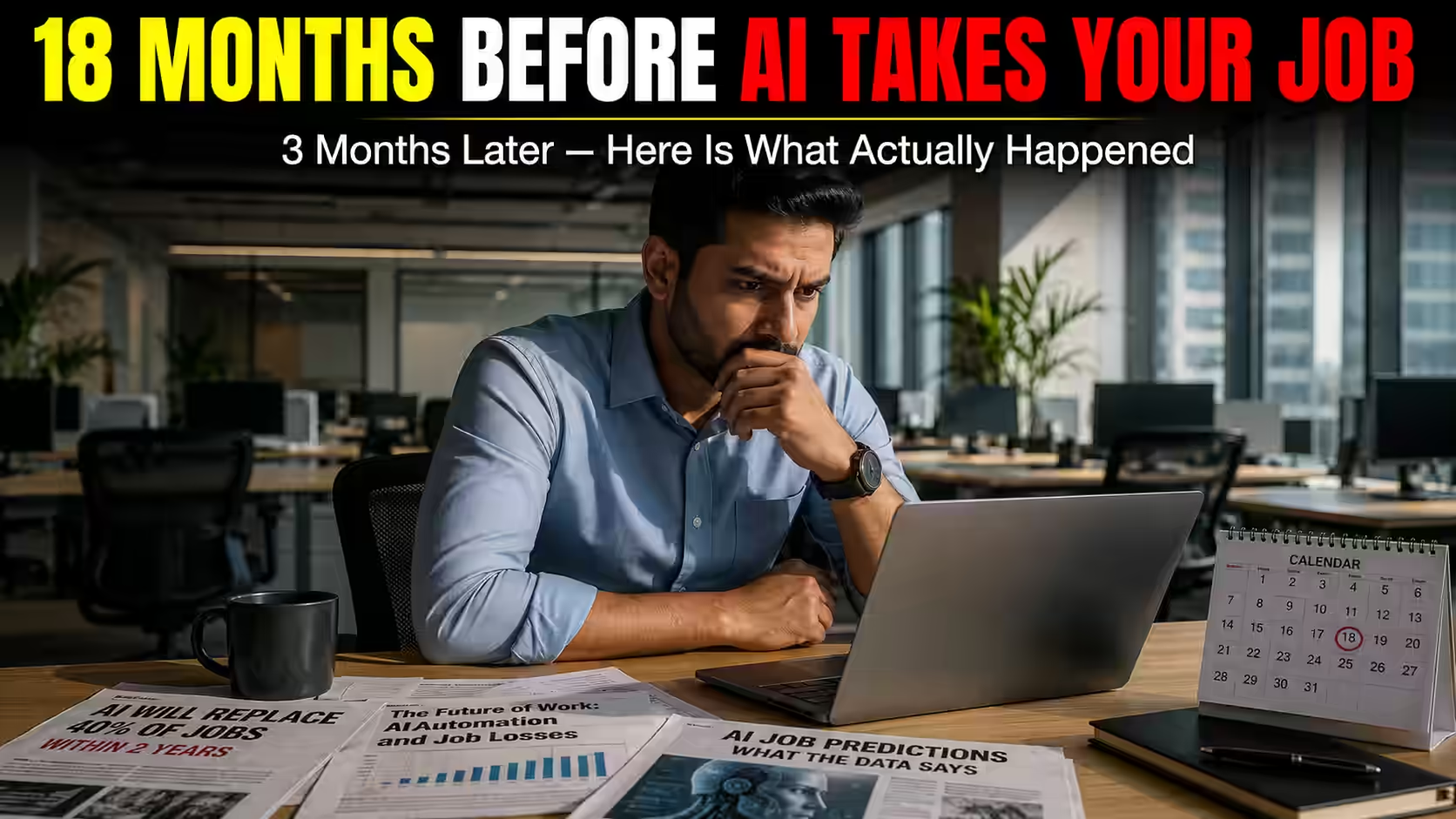
Three months ago, one of the most powerful men in artificial intelligence made a prediction that stopped millions of office workers cold.
Mustafa Suleyman, the CEO of Microsoft AI, sat down for an interview with the Financial Times and said something very direct. Within 12 to 18 months, he said, most white-collar professional work will be fully automated by AI. Lawyers. Accountants. Project managers. Marketing professionals. All of it.
The statement spread instantly. It was shared millions of times. It was debated in offices, on LinkedIn, in family WhatsApp groups. It landed in India, in the United States, in Europe. People who had spent years building careers started asking uncomfortable questions.
Three months have now passed since that interview.
So here is the question nobody in the media is asking directly: What has actually happened in those three months? Is the prediction holding up? What does the real data say — not the forecasts, not the theories, but the actual numbers from the job market right now?
The answer is more complicated, and more important, than either side wants to admit.
BACKGROUND
To understand why Suleyman’s words hit so hard, you have to understand who he is and what he has built.
Mustafa Suleyman did not come up through the usual Silicon Valley path. He co-founded DeepMind in London in 2010 — one of the most respected AI research labs in the world. Google acquired DeepMind in 2014. He stayed on for years before eventually leaving and co-founding Inflection AI, another major player in the field. In 2024, Microsoft hired him to lead its entire AI division — one of the most powerful AI roles at one of the world’s most valuable companies.
When Suleyman speaks, people listen. Not because he is famous in the way Elon Musk is famous, but because people in the industry know his track record. He has been in this field longer than most. His predictions carry weight.
His February 2026 statement was not the first warning of its kind. Anthropic CEO Dario Amodei had warned in 2025 that AI could wipe out half of all entry-level white-collar jobs. Ford’s CEO said AI would cut white-collar employment in the United States in half. An essay by AI researcher Matt Shumer, comparing this moment to February 2020 just before the pandemic hit, was viewed 85 million times on X in a single week.
But Suleyman’s prediction had a specific, measurable timeline. Eighteen months. That is short enough to be alarming. Short enough to be tested. And that is exactly what makes this story different from every other AI-and-jobs article being published right now.
Eighteen months from February 2026 is approximately September 2027. For his prediction to be correct, the transformation of professional work would need to be clearly visible, measurable, and accelerating right now — in the data that already exists.
Three months in, we can start checking.

MAIN UPDATE
Here is what the data shows — three months after the prediction.
The most direct number comes from outplacement firm Challenger, Gray and Christmas. In 2025, companies directly pointed to AI in announcing 55,000 job cuts — more than 12 times the number of AI-attributed layoffs just two years earlier. That number is real. The direction is real.
But the full picture is more complicated.
Amazon has cut roughly 30,000 corporate positions since late 2025, explicitly flattening management layers. Morgan Stanley cut 2,500 positions in early March 2026, targeting coordination and back-office roles, after posting record revenue.
That last detail matters. Record revenue. While cutting jobs. That is not AI replacing workers. That is a company becoming more efficient — and keeping the profits rather than the headcount.
Some companies have outright said they are replacing workers with AI. Klarna CEO Sebastian Siemiatkowski said the company was able to shrink its headcount by about 40%, in part because of AI. Duolingo said it would stop using contractors for work that AI can handle. Salesforce laid off 4,000 customer support roles, saying that AI can do 50% of the work.
These are real examples. They are happening. But they are concentrated in specific types of work — customer support, content creation, data entry, basic coding. They are not the full-scale collapse of professional work that Suleyman described.
Here is the number that tells the most honest story.
Anthropic researchers found that actual AI adoption is just a fraction of what AI tools are theoretically capable of performing. AI can theoretically cover most tasks in business and finance, management, legal, and office administration. But in most sectors, actual adoption is just a fraction of what is technically possible.
In other words: the capability is there. The adoption is not keeping pace.
Fortune noted that three months after Suleyman’s prediction, mounting evidence shows AI is falling short of its promised productivity revolution, even as some models continue to improve.
And then there is this finding — the one that nobody saw coming.
A study on AI’s impact on software developers — the workers who are arguably most exposed to AI automation — found that the technology actually made workers’ tasks take 20% longer. More time, not less. The AI was getting in the way.
That single result does not disprove everything. But it does tell you that the 18-month timeline may be built on assumptions that do not yet match the ground reality.

IMPACT ANALYSIS
The real impact of this story is not happening where most people are looking.
Goldman Sachs estimates AI is already reducing U.S. employment by roughly 16,000 jobs per month. But at the same time, demand is rising in adjacent areas — data centers, AI development — creating new roles even as others disappear.
The job losses are real. They are just not distributed the way the prediction suggested.
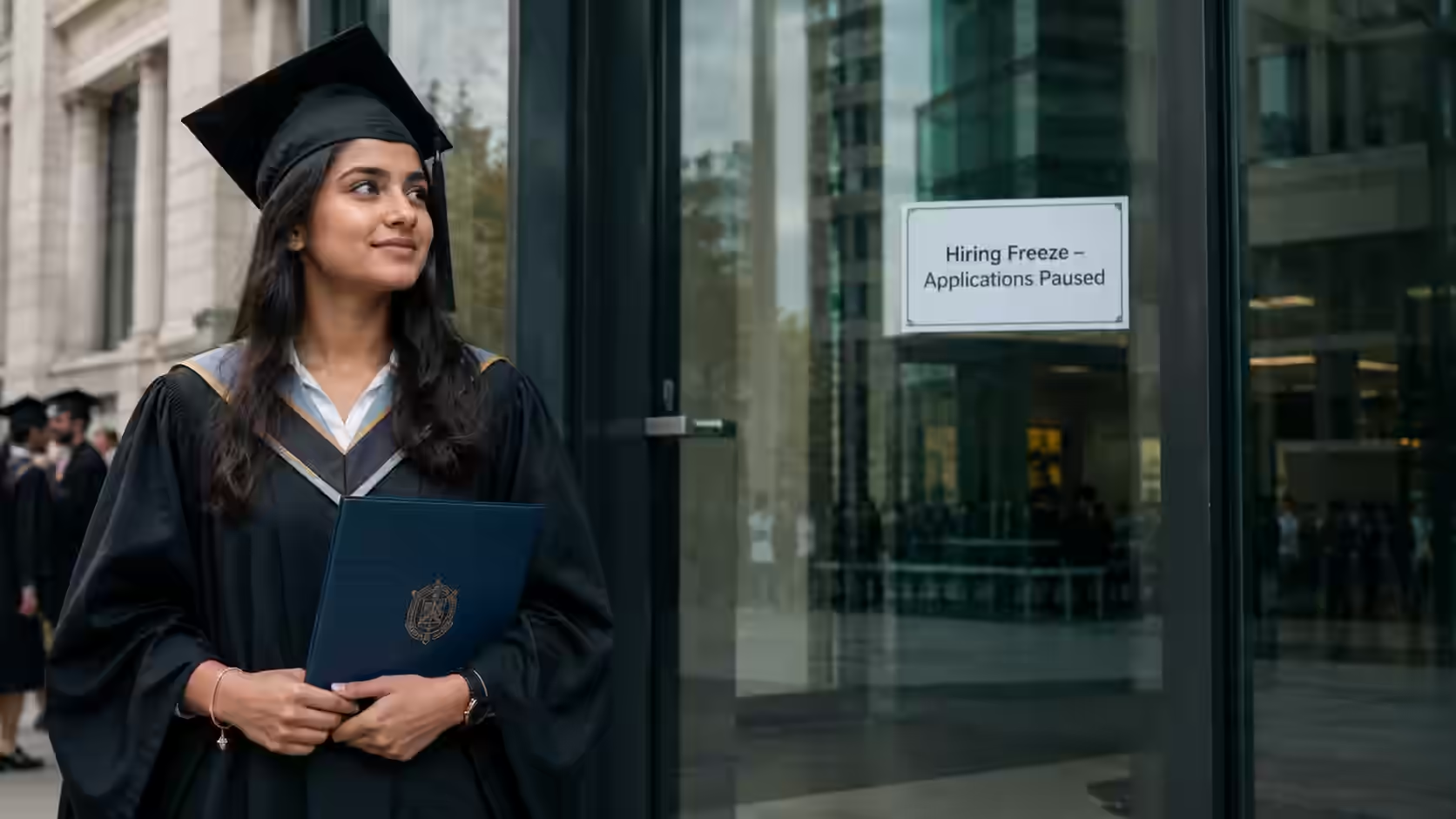
What is actually happening is this: companies are not firing their existing lawyers, accountants, and project managers in large numbers yet. They are doing something quieter and, in some ways, more damaging. They are simply not hiring new ones.
The problem is not that the AI jobs debate is exaggerated. It is being framed incorrectly. The changes are already happening — just quietly. Many firms are silently closing the door to new hires rather than laying off existing staff.
This matters enormously for young people. A law graduate entering the job market in 2026 faces a different world than the one that existed in 2022. The firms are not hiring the same number of junior associates. The accounting firms are not onboarding the same cohorts of entry-level staff.
Economists remain cautious about drawing a straight line from AI to white-collar declines. Companies announcing AI-attributed layoffs may be using the technology as cover for cost cuts after over-hiring during the pandemic.
That word — “AI-washing” — is now being used by serious labor economists. Some companies, the evidence suggests, are blaming AI for layoffs that were coming anyway. The technology is real. The hype around it is also real. Separating the two is harder than either side admits.
For people with established careers in law, accounting, and marketing, the short-term risk is lower than Suleyman’s timeline suggests. For people just starting those careers, the risk is considerably higher.
FUTURE OUTLOOK
Three months in, the honest assessment is this: Suleyman is right about the direction. He may be wrong about the speed.
The shift from AI as a tool to AI as a replacement is real and is accelerating. But it is moving through specific entry points — customer support, junior coding, content creation, data analysis — not through the broad, simultaneous collapse of all professional work that his 18-month timeline implies.
Morgan Stanley urged calm, reminding investors that while AI will alter the labor force, it will not permanently replace it. The firm predicted a wave of entirely new corporate roles — Chief AI Officers, computational geneticists, predictive maintenance engineers, and new product manager hybrids built around working with AI systems.
The more likely scenario, supported by the data available today, is a transformation that takes three to five years rather than 18 months — and one that hits different people very differently.
For senior professionals with deep expertise and client relationships, the near-term risk is low. For junior professionals doing routine document review, data entry, first-draft writing, or standard code, the risk is already here.
A ResumeTemplates survey of 933 U.S. executives found that 60% agree with Suleyman’s basic prediction. But the same data showed that most companies are in the early stages of AI adoption — not the final stages.
The question is no longer whether this will happen. The question is whether the 15 months remaining in Suleyman’s timeline are enough for the transformation to reach the scale he described.
Based on where things stand today, the answer is probably not. But the direction he pointed to is not wrong. He may simply be describing 2028 while calling it 2027.
That is a small comfort to someone graduating in 2026.

EXPERT INSIGHTS
- Mustafa Suleyman, CEO Microsoft AI (February 2026): “I think we’re going to have human-level performance on most, if not all, professional tasks. White-collar work — lawyers, accountants, project managers, marketing — most of those tasks will be fully automated by an AI within the next 12 to 18 months.”
- Dario Amodei, CEO Anthropic (2025, updated 2026): Initially predicted AI could wipe out half of all entry-level white-collar jobs. Recently updated that view — acknowledging the timeline is harder to predict than first suggested.
- Tom Davenport, Professor at Babson College: Surveyed over 1,000 executives in late 2025 and found that only a small fraction had implemented AI in ways that reduced headcount. Most were using it to augment existing workers, not replace them.
- Goldman Sachs analysis (2026): Estimates AI is already reducing U.S. employment by roughly 16,000 jobs per month — while simultaneously creating new adjacent roles in AI infrastructure and development.
- Laks Ganapathi, Founder of Unicus Research (February 2026): “Companies will lean as much as they can, as fast as they can with AI. And that is going to cut a lot of jobs. Some companies in the process are going to completely stop existing as a going concern.”
- Lisa Simon, Chief Economist at Revelio Labs: “Companies want to get rid of departments that no longer serve them. And I think, for now, AI is a little bit of a front and an excuse.” She posits that AI is having more impact on hiring than on layoffs — companies pulling back on new hires more than firing existing staff.
- Morgan Stanley (2026): Urged investors not to panic — predicted that AI will create a wave of new corporate roles even as it eliminates others, naming “Chief AI Officer” and AI-specialized engineering positions as the next generation of white-collar work.
KEY TAKEAWAYS
- Microsoft AI CEO Mustafa Suleyman predicted in February 2026 that AI would fully automate most white-collar professional work — lawyers, accountants, project managers, marketers — within 12 to 18 months.
- Three months later, 55,000 AI-attributed job cuts have been confirmed in 2025 data — but economists warn some companies may be “AI-washing” ordinary layoffs by blaming the technology.
- Amazon cut 30,000 corporate positions and Morgan Stanley cut 2,500 roles while posting record revenues — a pattern that points to efficiency gains, not mass AI replacement of skilled workers.
- Anthropic’s own research found that actual AI adoption in most professional sectors is a fraction of what the technology is theoretically capable of — meaning the tools exist but companies have not fully deployed them yet.
- A major study found that AI tools made software developers’ tasks take 20% longer — suggesting that in some roles, AI is currently slowing workers down rather than replacing them.
- The impact is landing hardest on people entering the workforce, not those already in it. Many firms are quietly freezing entry-level hiring rather than firing existing professionals.
- Goldman Sachs estimates AI is already cutting roughly 16,000 jobs per month in the United States — while creating new jobs in AI development and infrastructure at the same time.
- The honest assessment: Suleyman is right about the direction. He may be describing 2028 while calling it 2027. The 18-month timeline is aggressive — the transformation is real but moving through narrow entry points, not through an industry-wide collapse.
CONCLUSION
Mustafa Suleyman did not make this prediction to scare people. He made it because he believes it. And based on the direction of the evidence — the layoffs, the hiring freezes, the quiet disappearance of entry-level roles — he is not wrong about what is coming.
What the three-month data check reveals is that the speed is the question, not the destination.
White-collar work is changing. The process has started. But it is moving through the bottom of the career ladder first, not through a sudden collapse of every profession at once.
If you are mid-career, you likely have time to adapt. If you are just starting, the window is narrowing faster than anyone is admitting publicly.
What do YOU think — is your job safe in the next 18 months? Drop your thoughts below. Share this with one person who needs to read it before it is too late. Follow AI Today’s News to stay ahead every day.