


Table of Contents ( Anthropic India )
INTRODUCTION
Something shifted quietly in October 2025 — and most people missed it.
Dario Amodei, the CEO of one of the world’s most powerful AI companies, flew to New Delhi. Not for a conference. Not for a panel discussion. He walked into a room with Prime Minister Narendra Modi and had a direct conversation about the future of artificial intelligence in India.
That single meeting set off a chain of events that, by May 2026, had turned into a Bengaluru office, a $1.5 billion investment deal backed by Goldman Sachs, and a confirmed position for India as the world’s second-largest market for Claude — Anthropic’s flagship AI model.
This is not a story about a company entering a new market. This is a story about a company betting its future on India. And based on what has happened in the last seven months, it appears to be a very calculated bet.

BACKGROUND — The Road That Led Here
To understand why this moment matters, you have to go back a few years.
Anthropic was founded in 2021 by Dario Amodei and his sister Daniela Amodei, along with several other former OpenAI researchers. From the beginning, the company positioned itself differently — not just as an AI developer, but as an AI safety company. Their entire mission was built around building AI systems that were steerable, interpretable, and safe.
For its first few years, Anthropic operated mostly in the shadows of OpenAI and Google. It built Claude, its conversational AI model, and slowly grew a base of enterprise clients. But the company’s real inflection point came in 2024 and 2025, when Claude began outperforming competitors in key enterprise tasks — particularly in coding.
Claude Code, Anthropic’s agentic coding tool, launched publicly in mid-2025. Within months, it had become one of the most widely used AI developer tools on the planet. Revenue started doubling. Then doubling again. By early 2026, Anthropic had a revenue run-rate of $14 billion, growing at over 10x annually.
India, during this same period, was quietly becoming something unexpected — Anthropic’s fastest-growing market outside the United States.
The numbers were hard to ignore. India ranked second globally in consumer usage of Claude. A disproportionately large share of that usage was technical — mobile UI development, web app debugging, and backend engineering. Indian developers were not just using Claude casually. They were using it seriously.
That pattern caught Amodei’s attention. And in October 2025, he decided to act on it.

MAIN UPDATE — Three Moves That Changed Everything
Move 1 — The PM Modi Meeting (October 2025)
On October 11, 2025, Dario Amodei met Prime Minister Narendra Modi in New Delhi.
The agenda was not vague. Amodei came with specific numbers and a specific message. He told Modi that Claude Code usage in India had grown five times since June 2025. He said that how India deploys AI across education, healthcare, and agriculture — for over one billion people — would be essential in shaping the future of AI globally.
Modi’s government had already been pushing its own AI agenda under the “AI for All” initiative. Amodei’s visit aligned directly with that framework.
After the meeting, Amodei posted on X: “Today I met with PM @narendramodi to discuss Anthropic’s expansion to India — where Claude Code use is up 5x since June. How India deploys AI across critical sectors like education, healthcare, and agriculture for over a billion people will be essential in shaping the future of AI.”
That single post confirmed what many had suspected — India was no longer a secondary market for Anthropic. It was a primary one.
Move 2 — The Bengaluru Office Opens (February 2026)
Four months after the Modi meeting, Anthropic officially opened its Bengaluru office — its second location in the Asia-Pacific region, after Tokyo.
The company announced Irina Ghose as the Managing Director for Anthropic India. Ghose brought deep experience in the Indian enterprise technology market and was specifically chosen to build partnerships with Indian businesses, nonprofits, and startups.
At the Bengaluru Builder Summit held the same week, Amodei delivered a statement that stopped the room. He revealed that Anthropic’s revenue run-rate within India had doubled in just four months. Claude Code had grown even faster than that.
“It’s really incredible to see the rate at which things are happening,” Amodei said. “It mirrors the general progress of the explosion in Claude models and coding models. But it’s even more extreme in India than we have seen in other places in the world.”
The company also announced a strategic partnership with Infosys — one of India’s largest technology companies — signaling that Anthropic was not just selling software to Indian developers. It was embedding itself into the core of India’s enterprise technology infrastructure.
Also revealed that week was something particularly striking: the Ministry of Statistics was building a specialized server to query economic data using Claude. Government bodies in most countries do not move this fast. The fact that an Indian government ministry was already deploying Anthropic’s technology at an institutional level was a signal most analysts had not expected so soon.
Move 3 — The $1.5 Billion Joint Venture (May 2026)
Then came the move that made it official.
In early May 2026, just days after Anthropic officially launched its India AI services on May 5th, the company announced a $1.5 billion joint venture. The partners were Blackstone, Hellman & Friedman, Goldman Sachs, and General Atlantic — four of the most powerful financial institutions on the planet.
The purpose of this venture was direct: deploy Claude inside enterprises at scale. Not just offer it as a subscription. Actually embed it into the operations of major companies across India and beyond.
This was not a software sales strategy. This was an infrastructure play. Anthropic was positioning Claude as foundational enterprise technology — the kind that companies build their operations on top of, not simply use as a tool.

IMPACT ANALYSIS — What This Means for India
The short-term effects are already visible.
Indian IT giants are feeling pressure. TCS and Wipro both reported weak revenue growth in early 2026. Analysts are connecting that directly to the arrival of frontier AI companies like Anthropic and OpenAI, which are now competing for the same enterprise contracts that India’s outsourcing industry has traditionally owned.
Experts quoted by The Economic Times, however, offered a more balanced view. They suggested that while frontier AI companies will capture the higher-value strategy and transformation layers of enterprise AI, Indian IT firms will likely be needed for large-scale implementation and execution. The relationship may evolve into partnership rather than pure competition.
For individual Indian developers, the picture is genuinely exciting. Claude Code is growing faster in India than anywhere else in the world. Indian developers now have access to one of the most capable AI coding tools ever built, and they are using it at a level that has surprised even Anthropic’s own leadership.
The government angle is equally significant. When a private AI company begins partnering directly with Indian ministries on data infrastructure, it shifts the nature of the relationship between technology and governance in ways that take years to fully understand.
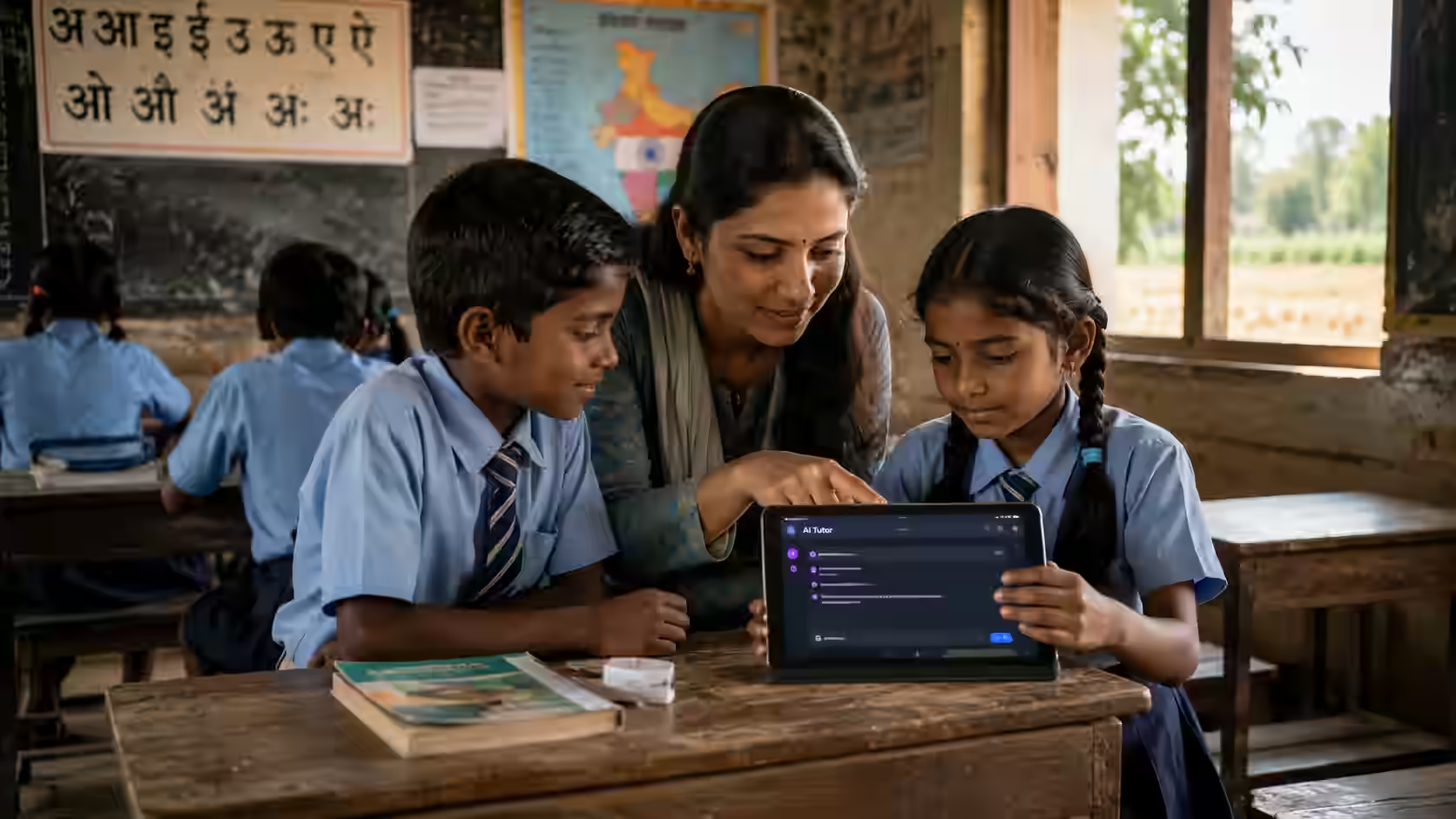
On the education side, Anthropic announced two weeks ago — on May 14, 2026 — a $200 million partnership with the Gates Foundation specifically targeting India and Sub-Saharan Africa. The focus is K-12 students. AI-powered apps for literacy and numeracy. Tools built in Hindi and nearly a dozen other Indian languages including Bengali, Marathi, Telugu, Tamil, Punjabi, Gujarati, Kannada, Malayalam, and Urdu.
For the first time, AI tools designed by a frontier company are being built specifically for Indian children, in Indian languages, for Indian classrooms.
FUTURE OUTLOOK — What Comes Next
Dario Amodei has been unusually direct about where he thinks this is all heading.
In January 2026, he published a 20,000-word essay titled “The Adolescence of Technology.” In it, he warned that AI could displace up to 50% of entry-level white-collar jobs within one to five years. He predicted that software engineers could be replaced by AI within six to twelve months. He projected that by 2028, AI would reach Nobel-level scientific research capability.
Those are not the words of a person trying to sell software. Those are the words of someone who genuinely believes the technology is moving faster than most people are prepared for.
For India specifically, Amodei’s public statements point to a country that is uniquely positioned — not just to adopt AI, but to shape how it develops globally.
India has the world’s largest working-age population. It has proven digital public infrastructure through systems like UPI and Aadhaar. It has a deep technical talent base. And it has a government that is, by Amodei’s own account, moving faster on AI adoption than almost any government he has seen elsewhere.
“The efficiency of the market here, the energy of very large numbers of people wanting to buy something and build something — that greatly exceeds what I’ve seen anywhere else,” Amodei said at the AI-India Impact Summit in early May 2026.
The localized API support, regional language capabilities, and direct enterprise infrastructure investments suggest Anthropic is not treating India as a market to enter. It is treating India as a market to anchor itself in — for the long term.
By late 2026, localized APIs from Anthropic are expected to be available to Indian developers. Expanded Indic language support is already in progress. The Bengaluru office is actively hiring.

EXPERT INSIGHTS
- Dario Amodei, CEO Anthropic: “India’s technical intensity of Claude usage is unlike anything we have seen in other markets worldwide. It mirrors global progress but at an even more extreme pace.”
- Irina Ghose, MD Anthropic India: Named specifically to lead India operations, signaling Anthropic’s intention to build deep local relationships rather than manage India remotely.
- Paul Smith, Chief Commercial Officer, Anthropic: “Indian enterprises and startups are seeking AI models they can trust — systems that combine frontier performance with safety and reliability at massive scale.”
- Economic Times analysts: Suggested that frontier AI companies will capture high-value strategic layers of enterprise AI while Indian IT firms handle implementation — pointing to partnership rather than pure displacement.
- Outlook Business: Noted that the rise of Anthropic and OpenAI is already intensifying pressure on India’s traditional IT services model, with TCS and Wipro facing investor shifts toward AI-led tech markets.
- India AI Impact Summit observers: Flagged that the Ministry of Statistics building a specialized Claude-powered server for economic data queries was a rare and significant signal of government-level AI adoption moving at startup speed.
KEY TAKEAWAYS
- Dario Amodei met PM Modi in October 2025 — confirming India as a strategic priority for Anthropic at the highest level.
- Claude Code usage in India grew 5 times between June and October 2025 alone.
- Anthropic opened its Bengaluru office in February 2026 — its second Asia-Pacific location after Tokyo.
- India is now Anthropic’s second-largest market for Claude globally, behind only the United States.
- Anthropic’s India revenue run-rate doubled in just four months — faster than any other market.
- A $1.5 billion joint venture with Goldman Sachs, Blackstone, and others was announced in May 2026 to deploy Claude inside enterprises at scale.
- Anthropic and the Gates Foundation announced a $200 million partnership on May 14, 2026 to build AI education tools for Indian children in local languages.
- Claude now supports Hindi and nearly a dozen Indian languages including Bengali, Telugu, Tamil, Marathi, and Urdu.
- Indian IT firms TCS and Wipro are already feeling revenue pressure from the arrival of frontier AI enterprise services.
- Amodei has publicly predicted that 50% of white-collar jobs could be displaced by AI within 1 to 5 years — a warning that hits India’s massive services economy directly.
CONCLUSION
Seven months ago, one meeting in New Delhi started something that most people had not yet noticed.
By May 2026, that meeting had turned into a Bengaluru office, a $1.5 billion investment, a Gates Foundation education deal, and a confirmed position as Anthropic’s second-largest global market.
India did not just attract a tech company. India attracted one of the most consequential AI companies ever built — at the exact moment that AI is beginning to reshape how economies, governments, and classrooms function.
The question is not whether AI will transform India. That appears to already be happening. The question is whether India is ready to shape that transformation on its own terms.
What do YOU think about Anthropic’s bet on India? Drop your thoughts below. Share this with one person who follows India’s tech story. Follow [AI TODAYS NEWS] to stay ahead every day.